
- Resources
- Application Stories
- RICO-MX8P Hospital Medication Delivery Robot

Distributing medication to patients in hospital environments requires a great deal of time and effort from nurses, which can be a problem given the range of complex tasks they perform throughout shifts.
In an effort to change this, one healthcare equipment provider developed an automated medication delivery cart. To do so, the company employed AAEON’s RICO-MX8P, a fanless Pico-ITX single-board computer powered by the NXP i.MX 8M Plus processor platform.
Diagnosing Pain Points
During discussions with the AAEON sales team, the company noted that because they had experience in developing autonomous and automated robotic solutions, they were not seeking a fully integrated platform upon which to build the entire application. Rather, they were seeking a compact solution that would act as the medication delivery cart’s central robotic controller.
Therefore, they would not require the controller to execute data-intensive workloads such as navigation and obstacle avoidance, but instead act as a bridge between the hospital server and the core robotic unit itself. With this in mind, the company listed a number of key functions that any potential embedded platform needed to have for the application to function.

The first requirement was that the solution had adequate connectivity, for two reasons. The first was because it would need to exchange data with both the hospital server and the robot. Meanwhile, the platform needed sufficient wired connectivity in order to support a number of peripheral devices, such as RFID card readers and QR code scanners.
As it would be deployed in a space-constrained unit in a clinical environment, the solution also needed to be compact and avoid dust accumulation. Therefore, modest power consumption and fanless design were both essential.
The final request was less to do with the hardware itself, and more about the software integration support the chosen embedded partner could offer. This was because the medication delivery cart would require a custom user interface. As such, the customer placed a great deal of value on the technical capabilities of the provider it chose to work with on the project.
Prescription: AAEON’s RICO-MX8P

During the evaluation phase, it became evident that AAEON’s RICO-MX8P was the most suitable hardware for the application. A second major reason for the customer’s choice was the level of service AAEON could offer when it came to integration and deployment.
Dual-network Configuration
The RICO-MX8P offered both an RJ-45 LAN port and an M.2 2230 E-Key slot. As such, it was ideal for the dual-networking the application demanded, with wired Ethernet used to interface with the cart’s robotic and I/O modules and Wi-Fi module support providing data exchange with hospital servers.
Multi-Peripheral Support
With two USB 3.2 Gen 1 ports, the RICO-MX8P could connect to a USB hub, maintaining enough bandwidth for all peripherals to be supported through a single upstream interface. In addition to this, the RICO-MX8P’s LVDS and HDMI display outputs were important features, used to feed the cart’s main touchscreen, while also routing data through an AD board for larger, alternative displays.
On-Call Software Integration
AAEON provided extensive UI customization and software integration support. For example, language localization and custom branding were implemented for user-friendliness, while unnecessary system components like permission pop-ups, drop-down settings menus, and screen locks were disabled to prevent tampering and expedite workflow.
Small Footprint
At just 100mm x 80mm and designed for fanless operation, the RICO-MX8P was a very practical option for the application, where it would need to be deployed within a compact unit with minimal outside airflow. Moreover, the board’s NXP i.MX 8M Plus platform offered quad-core Arm® Cortex®-A53 and M7 processing for handling multiple concurrent workloads with a very low power draw.
Method of Action
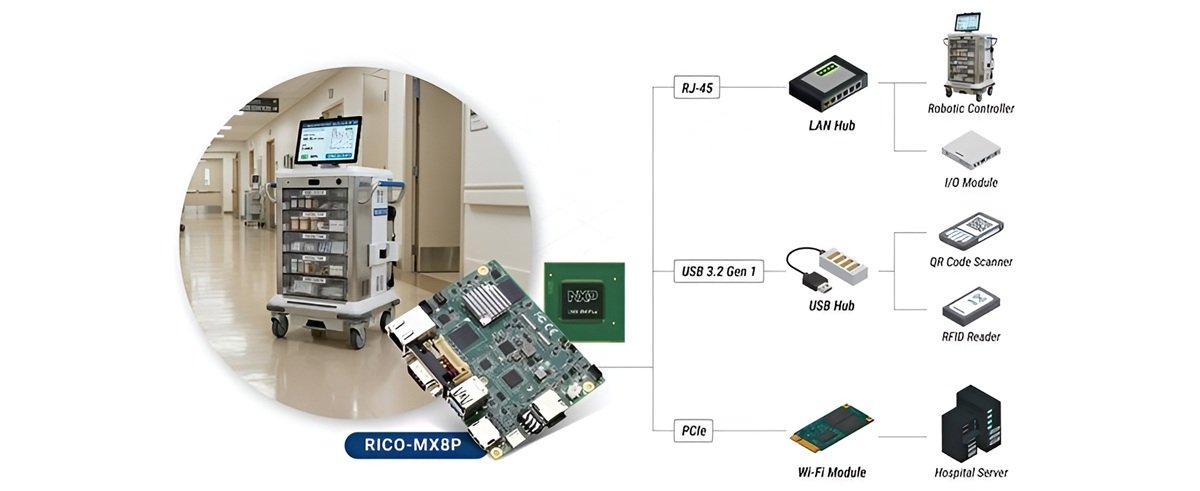
To access the system, nurses would verify they had permission to access the medication cart by scanning ID badges via an RFID reader connected through the USB hub to one of the RICO-MX8P’s USB ports.
Next, the cart’s LVDS-connected touchscreen panel would show a list of tasks, organized by nursing station. When a medication order had been selected, the system cross-checked the medication order information with the records held by the hospital server.
The RICO-MX8P would then relay patient nursing station location data to the cart’s robotic controller and I/O module via its connected LAN hub, instructing the cart’s robotic controller to navigate to the corresponding station. Once this journey had been completed, the QR code on the patient’s admission bracelet would be scanned, triggering the specified cart drawer to open for the medication to be administered.
Finally, the Wi-Fi module, still communicating with the hospital server, would relay that the medication order had been fulfilled, synchronizing dispensing records to create a clear audit trail.
Rollout, Reception, and Impact
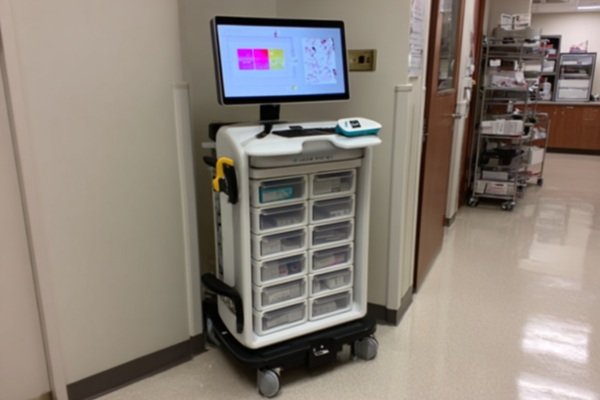
The customer has now deployed their medication delivery cart in clinical environments. While the application is still in its infancy, it is expected to have a substantial impact on how medication rounds are conducted. In settings such as outpatient chemotherapy wards where controlled drugs were often dispensed, nurses previously had to verify and sign-out medications from the pharmacy in person before returning to the patient to administer them.
Such a process adds a burden on healthcare professionals. By eliminating this process, the client’s medication delivery cart has the potential to reduce medical staff workloads by up to 40%. The capacity of the carts is also a critical factor. Able to carry out medication delivery for up to 20 patients per trip, the customer’s application is able to dramatically reduce the time required to complete medication rounds.
Finally, the medication delivery cart’s automatic locking compartments and multi-step authentication transform medication rounds into a secure process. This process not only results in records being more accurate, but has the additional benefit of reinforcing compliance with controlled substance handling regulations and reducing the potential for human error, resulting in more positive and safe patient outcomes.