- Маералы
- Возможнос прмененя
- Heavy Industry AI-driven Safety Monitoring
A major institution involved in large-scale heavy industry projects saw an opportunity to enhance safety monitoring at its worksites through the use of AI. Working with AAEON, the company was able to implement an AI-driven safety monitoring solution that addressed a broad range of risk areas, including equipment fault detection, personal protective equipment (PPE) compliance monitoring, and restricted materials tracking.
Laying the Foundations
The customer’s vision was ambitious, and it was obvious from the outset that the system chosen for their application would need to be extremely powerful. For example, to effectively track worker safety, equipment hazards, and hazardous material handling, the system would need to be capable of running multiple AI models concurrently.
Technical specifications aside, the company raised an even bigger concern during initial consultations, that being the environment the proposed solution would need to operate in. Involved in large infrastructure projects across Asia and the Middle East, the company felt that even the most rugged industrial embedded systems may struggle to cope.
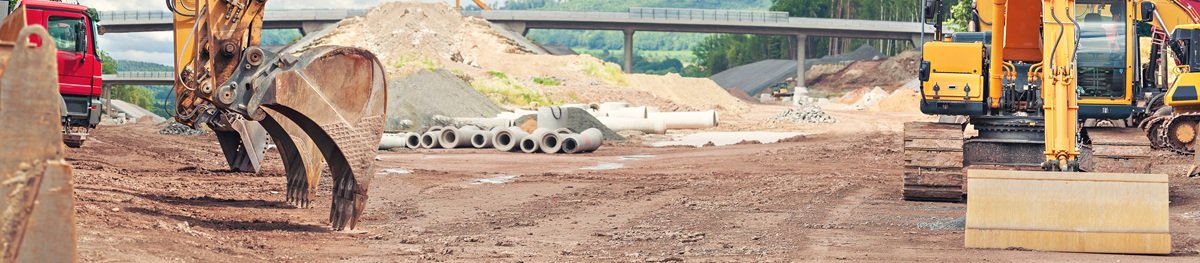
This was particularly pertinent when discussing the logistics of deploying a system of this type on their worksites in the Middle East, which were remote and open-air, exposing equipment to direct sunlight with outdoor temperatures exceeding 122°F (50°C) over sustained periods. Moreover, such settings presented further risks to embedded equipment, such as sand ingress and power supply variation due to reliance on solar energy.
Digging into the Details
From the beginning of the development process, it became clear that the success of the company’s application would come down to two things: whether the platform chosen could satisfy both the application’s AI performance needs and maintain stability under extraordinary environmental stress.
As the application would rely on multiple inference pipelines, the customer’s first choice was the BOXER-8641AI, an embedded AI system powered by the NVIDIA Jetson AGX Orin module. The reason for this choice was twofold. Firstly, the module’s 275 TOPS of AI performance meant it would be capable of running multiple concurrent AI models, which was essential for the application. The second reason was that the BOXER-8641AI provided NVIDIA Jetpack support, which would grant access to a number of pre-validated native AI frameworks conducive to building and deploying advanced inference pipelines.
Setbacks in the Search for Stability
Having established the technical suitability of the BOXER-8641AI, AAEON engineers worked with the company on testing and field validation. However, the evaluation showed that at just 180mm x 136mm x 79.1mm, the BOXER-8641AI was simply too compact to adequately deal with the heat it was exposed to. AAEON’s engineers were concerned that the combination of extreme outdoor temperatures, a high compute workload, and fine particle exposure caused the system to suffer repeated thermal reboots.
Because of this, AAEON suggested using the BOXER-8640AI, also powered by the NVIDIA Jetson AGX Orin module, but with a slightly larger 210mm x 164.2mm x 74mm profile. The reasoning behind this was that the system’s larger chassis would allow heat to be distributed more evenly, while also providing more internal space for the installation of a custom heatsink.
Turning Environmental Obstacles into Performance Advantages
As expected, the BOXER-8640AI’s larger form factor did result in more even heat distribution during preliminary testing. Still, AAEON’s engineers wanted to leave no room for error, fitting the BOXER-8640AI with a custom heatsink and built a reinforced enclosure to house it alongside other application hardware.
This enclosure not only reduced the impact of heat absorbed from sunlight, but also addressed the issue of sand ingress. For good measure, all of the BOXER-8640AI’s unused I/O ports were sealed as a second preventative barrier against sand ingress. Following these measures, the BOXER-8640AI was tested and showed it could maintain stability under extreme temperatures over sustained periods without any reduction in performance.
While a great deal of work went into refining the application’s hardware, this is not where AAEON’s service stopped. To reduce both the time and manpower required to achieve full operability, AAEON’s software team provided a custom OS image with all AI models preinstalled and configured for immediate use.
Application Architecture
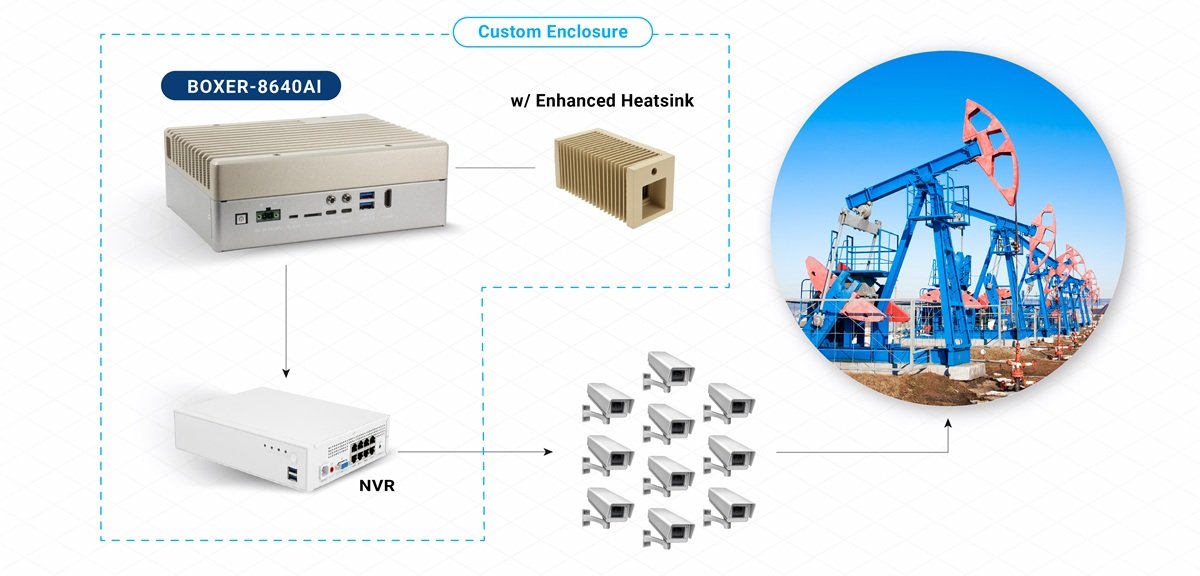
The application relied on three key components: the reinforced BOXER-8640AI, a network video recorder (NVR), and an extensive network of cameras spread across the site. Through the NVR, video streams from across the site were sent to the BOXER-8640AI via one of the system’s four Gigabit Ethernet RJ-45 ports. Utilizing its 12-core Arm Cortex-A78AE v8.2 CPU, the BOXER-8640AI then processed these high-resolution video streams both concurrently and in real-time.
Leveraging the enormous AI inference capabilities of its NVIDIA Jetson AGX Orin module, the BOXER-8640AI would then analyze the data and relay its findings to the site’s central control room via the enclosure’s external Ethernet port.
AAEON’s Impact
The effectiveness of the application was immediately apparent. Following deployment, the system provided alerts to the site’s central control room when imminent worker safety risks were detected. While the application’s aim was not to replace existing safety monitoring protocols, it served to expedite responses to critical situations.
The application also provided valuable insights into day-to-day operations, such as whether PPE compliance is maintained, hazardous materials are stored correctly, and minimum rest requirements are enforced. With this information, the company is now able to identify areas needing additional precautions or staff training to strengthen safety processes across worksites.
The success of this project not only reinforced the worker safety protocols of AAEON’s customer but illustrates how AI at the edge can enhance safety in sectors such as construction, mining, and natural resource extraction. The challenges overcome during development also serve as an example that even the most advanced embedded systems cannot be effective without considering the practical needs of end users.