- Маералы
- Возможнос прмененя
- UP 710S Intelligent Pick-and-Place Robotic Arm

A leading industrial automation specialist sought a product to power the next generation of their “pick-and-place” robotic arms. As an established systems integrator serving a broad customer base across different sectors, the customer required something both small and efficient enough to integrate into their robotic arm housing, yet equipped with an I/O capable of relaying control commands and driving servos and gripper actuators via multiple serial communication protocols. Having used the UP 4000 developer board for previous automation projects, the company approached AAEON to discuss the suitability of its newer single-board platforms.
The Need: A Credit Card-Sized Platform That Fits All
The customer’s robotic arm would be used for precision ‘pick and place’ material handling tasks on assembly lines, identifying small components based on a single image. To achieve this, multiple peripheral devices needed to operate in sync, meaning the embedded controller chosen to power the application would need to host a generous selection of compatible interfaces. In addition, it would need a processor sophisticated enough to run multiple simultaneous tasks without drawing excessive power or generating unnecessary heat.
Designed to be compact and easily incorporated into existing assembly lines, another big challenge for the customer was finding an embedded platform small enough to be integrated into its space-constrained housing without sacrificing interfaces critical to its functionality.
AAEON’s Top Pick: The UP 710S
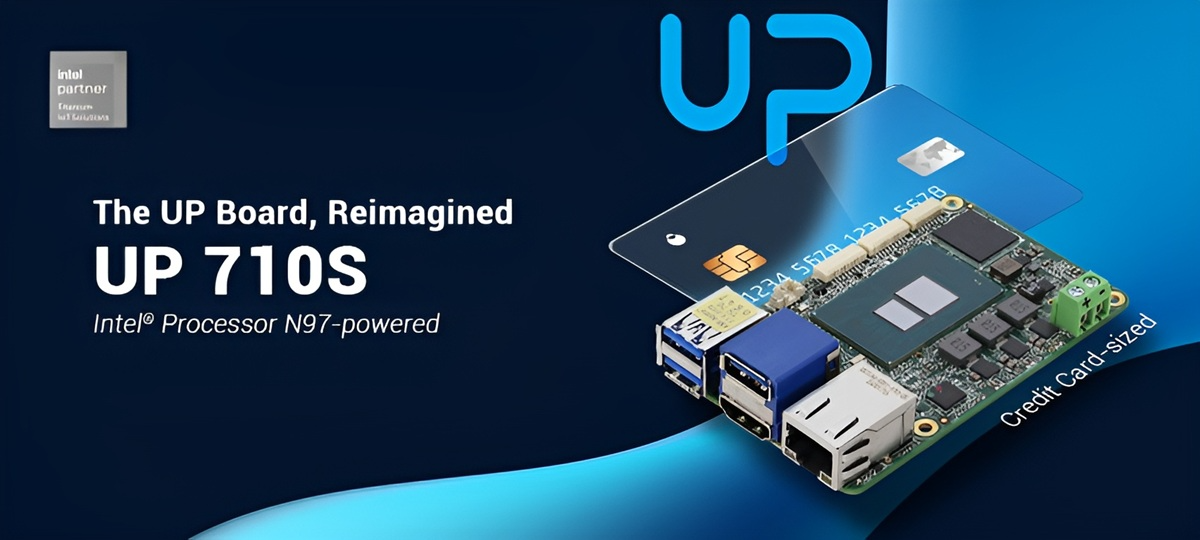
After exploring a number of options, the customer decided that the ideal platform was AAEON’s UP 710S, a credit card-sized developer board equipped with low-power embedded Intel® Processor N-series CPUs. This base was paired with a segmented, wafer-based industrial I/O. In combination, these features meant the UP 710S not only addressed the challenges the customer faced, but elevated the performance of the company’s existing pick and place solutions.
Compact, Slim Form Factor
Measuring just 85mm x 56mm, the UP 710S was an excellent option for discrete deployment within the robotic arm’s space-constrained housing. Further, the board’s layout was designed with the CPU on the I/O-side, resulting in a 10mm height reduction, a particularly attractive feature for maintaining adequate airflow in such a compact enclosure.
High-Resolution Camera Support
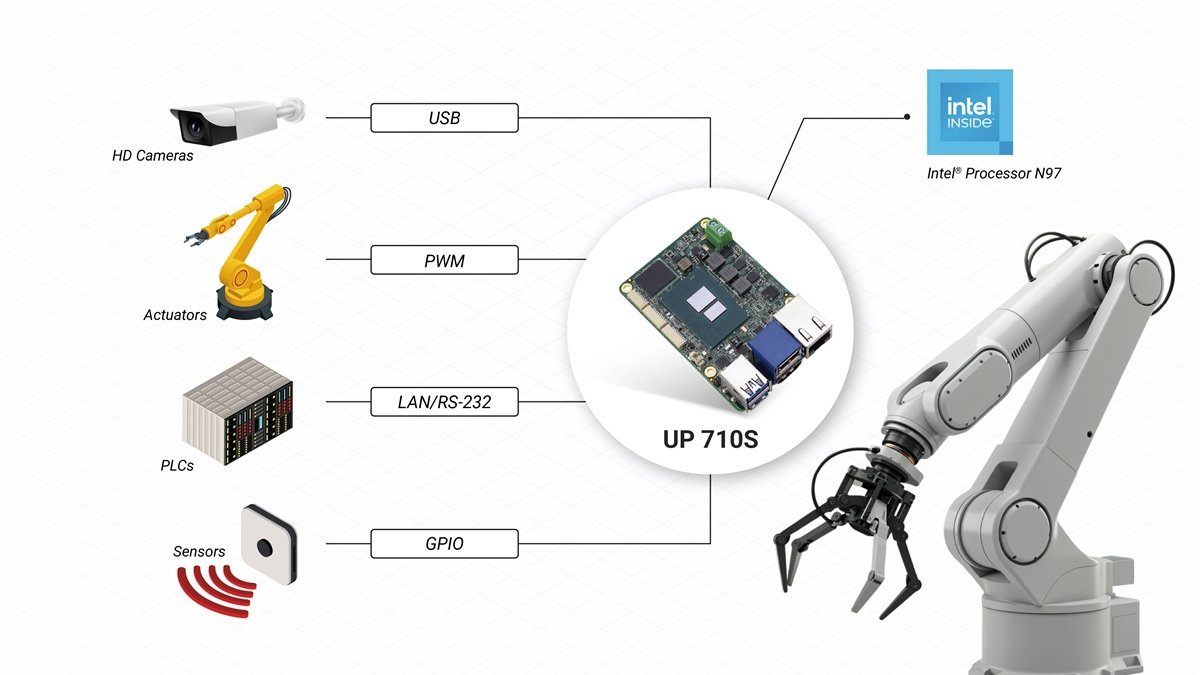
To capture images of each component for sorting, the customer installed USB cameras via the UP 710S’s three USB Type-A ports, providing the high-resolution image data essential for single-frame component detection. The USB 3.2 Gen 2 speeds offered by the UP 710S’s ports also provided high-bandwidth transmission speeds, reducing latency.
Intel® Processor N97 CPU
The UP 710S’s Intel® Processor N97 CPU offered four cores with a maximum single-core frequency of 3.60 GHz at just 12W. This fit the customer’s need for efficiency, while also being able to perform the computational tasks required to calculate motion trajectories. Moreover, the platform’s on-chip Thermal Monitoring Technologies provided the board with thermal management features tailored to regulate temperature and power consumption.
Accelerated Vision Processing
The Intel® Processor N97’s OpenCL support meant the board could offload image processing tasks from the CPU to its integrated Intel® UHD Graphics GPU, the 24 execution units of which could run operations like part recognition, convolution, and feature extraction in parallel, expediting single-frame analysis on images captured by the robotic arm’s cameras and reducing CPU workload.
Versatile I/O for Precise Control
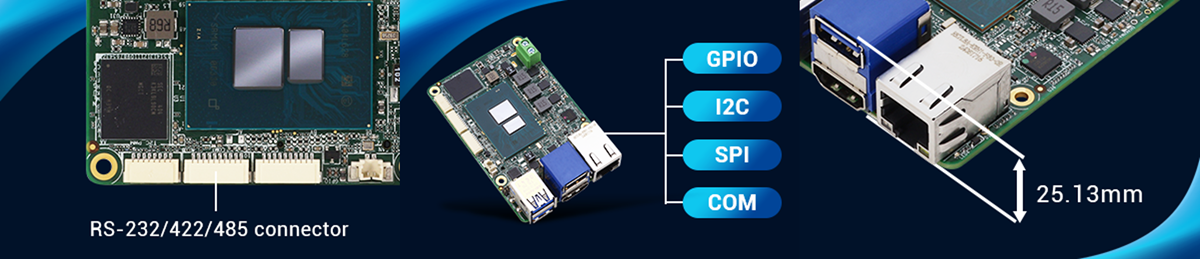
The UP 710S’s I/O included dedicated wafer connectors for a variety of serial communication signals to control the robotic arm. For control tasks, its 8-pin wafer provided two PWM signal outputs. Meanwhile, the board’s GPIO pins were used to interface with peripheral devices and trigger safety mechanisms.
The board’s LAN port and RS-232/422/485 header allowed the system to communicate with both the factory network and legacy equipment, respectively. As such, it could be deployed across different production lines and effectively interface with PLCs, HMIs, and specialized industrial controllers without additional hardware.
Application Architecture
Key Takeaways
By working with AAEON on this project, the customer was able to bring their compact, flexibly-deployed robotic arm to market within a period of just three months. Because the customer had previously worked with AAEON, the UP team was already familiar with the customer’s products, and was therefore able to provide detailed development support in several ways.
The first of these was the knowledge the AAEON team had of the actuator, sensor, and control circuit wiring configurations used by the customer’s robotic arm series. The fact that the UP Board form factor was already established as compatible with the robotic arm’s housing also helped, reducing the time needed to evaluate the product’s compatibility.
Secondly, AAEON’s position as an Intel® Prestige Partner meant that AAEON staff could accurately advise the customer on which processor would most suit the application. Consequently, the customer’s robotic arm benefitted from the Intel® Processor N97’s power-efficiency while offloading vision processing tasks to its Intel® UHD Graphics GPU for a balance of performance and efficiency.