- Маералы
- Возможнос прмененя
- Intelligent Fire Detection System
Executive Summary
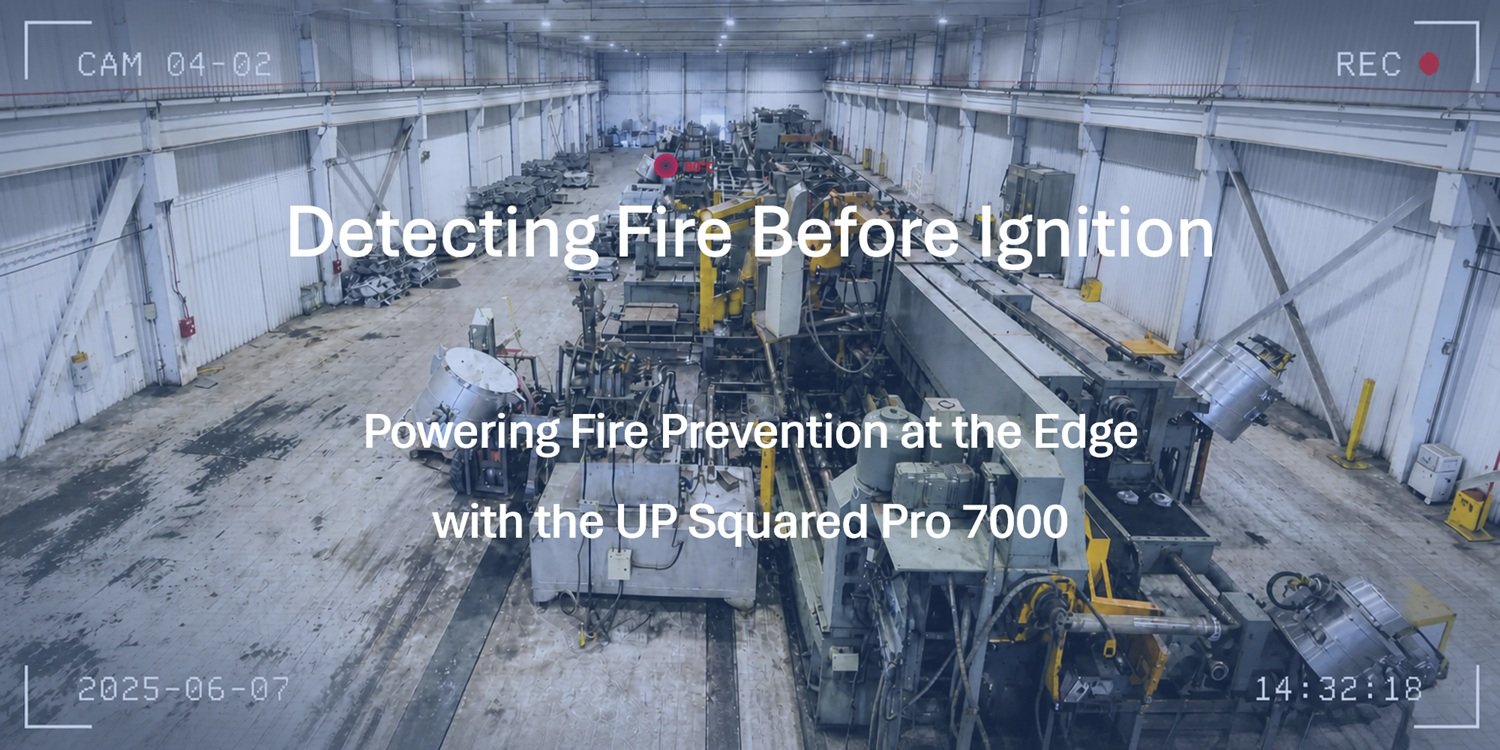
Material handling and processing facilities such as those found in the waste disposal and recycling, Refuse-Derived Fuel (RDF), and cement production industries share high-risk characteristics that make fire prevention an operational priority.
Many existing solutions are effective at detecting the byproducts of fires, such as the presence of smoke or flames. What they cannot do is recognize the signs that precede ignition, such as the temperature increases that may occur before smoke or flames are present.
Recognizing that identifying potential fire hazards before they develop into fires could make a significant difference, an industrial safety technology provider developed an intelligent camera monitoring system, using the UP Squared Pro 7000 from AAEON’s UP brand as its central computing platform. This monitoring system consisted of a mounted unit equipped with cameras capable of monitoring thermal signatures across large areas and generating automatic alerts when potential fire hazards were identified.
Key Platform Requirements
- Sufficient onboard computing performance to run the client’s proprietary thermal detection software, control equipment task coordination, and data ingestion from peripheral devices.
- Small enough to fit within the compact enclosure of an intelligent infrared camera system.
- Support continuous operation in demanding industrial environments that include wide temperature ranges, high levels of vibration, and the presence of fine particles like dust.
- Provide connectivity for cameras, control equipment, and other system peripherals.
- Support local detection and alarm processing without depending on cloud computing infrastructure.
- Able to execute continuous signal exchange with external control circuitry for alarm activation.
The UP Squared Pro 7000: The Intelligence Within the System
The client’s needs called for a combination of characteristics not typically found in a conventional embedded computer. Instead, they needed something with the low profile, power efficiency, and configurability of an embedded controller, combined with the advanced features and processing capabilities more commonly found in conventional, system-level industrial PCs.
The platform chosen would become an integral part of the intelligent camera system, meaning its mechanical dimensions, environmental characteristics, I/O, and compute foundation all needed to align with the unit’s design.
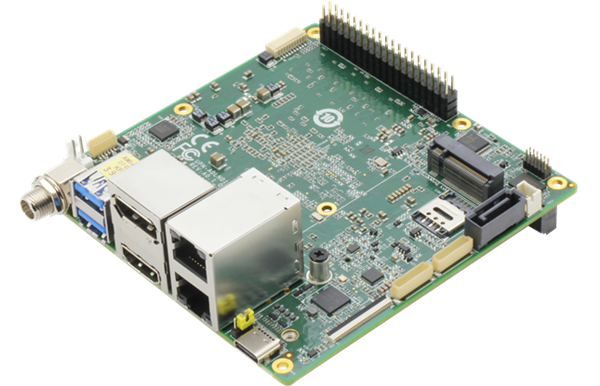
For the project, AAEON’s UP brand supplied a customized platform SKU featuring an Intel® Processor N97 CPU, 8GB of onboard LPDDR5 system memory, and 64GB of eMMC storage. Such a combination provided the processing resources and local storage required for the application software, while also accommodating its hardware requirements.
Versatile Camera Support
Central to the application’s value proposition was its use of both an infrared thermal imaging camera and a second, zoomable night vision-capable video camera. To support these, the UP Squared Pro 7000’s 61-pin FPC connector, which provided dual 4-lane MIPI CSI interfaces, was chosen.
This direct camera interface provided a high-bandwidth connection between the imaging devices and the processor, supporting efficient local image acquisition for the customer's thermal monitoring software.
Compact 4" x 4" Form Factor
Measuring just 4" x 4" and with its CPU, RAM, and storage onboard, the UP Squared Pro 7000 provided a practical balance between compactness and performance. It was small enough to install within the camera system’s enclosure, but was advanced enough to handle the customer's software and support the application’s camera and control architecture.
Intel Processor N97
The board’s 12W, quad-core Intel Processor N97 CPU provided the processing performance the application needed to run the customer’s thermal monitoring software and execute tasks like multi-channel data logging and visualization while maintaining a low-power envelope appropriate for a compact, enclosed camera system.
Controller & Subsystem Connectivity
The intelligent camera system used precision pan-and-tilt positioning to monitor a much larger area than would be possible with a fixed camera. To assist with this, the UP Squared Pro 7000’s configurable 10-pin header supporting RS-232/422/485 interfaces was used to communicate with the unit’s pan-and-tilt control subsystem.
This connection enabled the exchange of movement commands and position information with the dedicated pan-and-tilt controller, supporting repeated scanning of predefined monitoring areas.
Environmentally Robust Design
The intelligent camera system was designed for deployment in facilities where wide temperature ranges and high levels of vibration were common, making component durability crucial. The UP Squared Pro 7000’s design addressed this need. Because its CPU, RAM, and storage were soldered directly onto the board, potential points of failure associated with removable memory and storage modules, such as dislodgement, were avoided. Similarly, the UP Squared Pro 7000’s fanless design helped simplify the enclosure design and reduce moving components.
Meanwhile, to accommodate the application's wide operating-temperature requirements, the customer selected the UP Squared Pro 7000 WiTAS SKU, which supports an extended operating temperature range of -20°C to +70°C.
Application Architecture
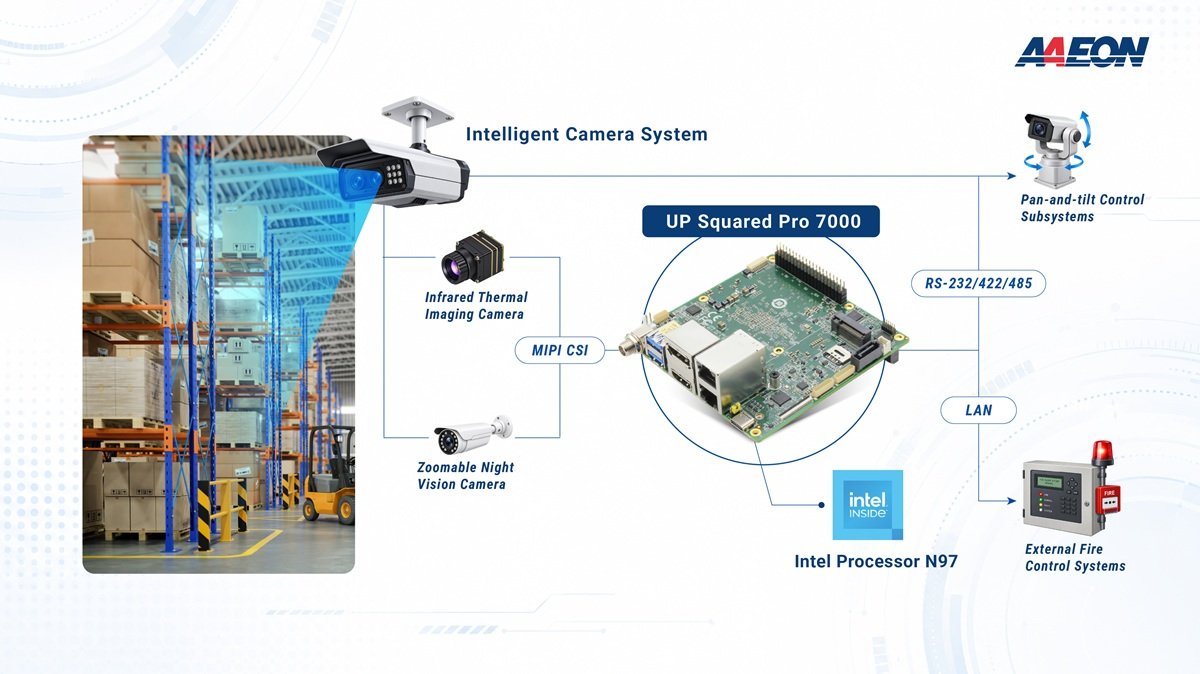
The customer's proprietary software analyzed incoming thermal data locally on the UP Squared Pro 7000, allowing the system to identify abnormal temperature behavior and initiate alarms without relying on cloud infrastructure. The client’s infrared and video cameras continuously captured each monitored area while the camera system’s pan-and-tilt controller repeatedly repositioned them to cover predefined zones.
As individual snapshots, these images provided only a limited view of the monitored environment, but the client’s proprietary software combined these individual scans into a continuous thermographic panorama, effectively creating a composite thermographic view of the monitored area. This meant the software could perform temperature analysis and hotspot localization in a way fixed-camera deployments could not.
When abnormal thermal activity was identified, or a temperature source exceeding a predefined threshold was detected, the camera system could autonomously issue an alarm and transmit the relevant data from the UP Squared Pro 7000 to external fire protection and control systems through its Ethernet interface. This meant potential fire hazards could be identified and action could be taken before ignition.
Business Impact
By prioritizing fire prevention over traditional detection, AAEON’s customer was able to take a novel approach to how hazards are addressed in high-risk heavy industry facilities. Pairing the UP Squared Pro 7000 alongside their innovative infrared and video camera technology, the company was able to develop an intelligent camera system that could perform both thermal analysis and system coordination locally, rather than relying on external cloud computing infrastructure.
This came with a number of benefits:
Earlier Detection
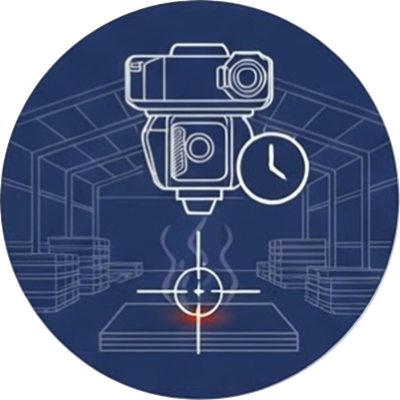
Continuous infrared monitoring enables facilities to detect changes that indicate there is a potential fire hazard, such as abnormal surface temperatures, allowing them to act prior to smoke or flames being present.
Fewer False Alarms
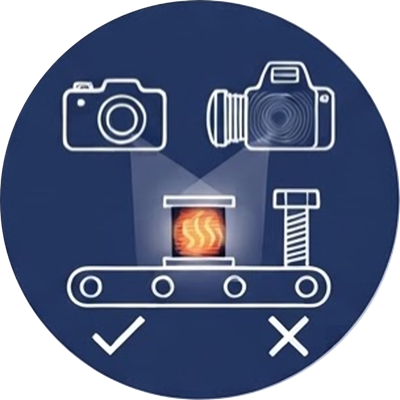
The customer’s thermal monitoring software, combined with the application’s dual camera setup helps distinguish genuine fire hazards from routine sources of elevated temperature, helping minimize unnecessary alarms.
Targeted Response
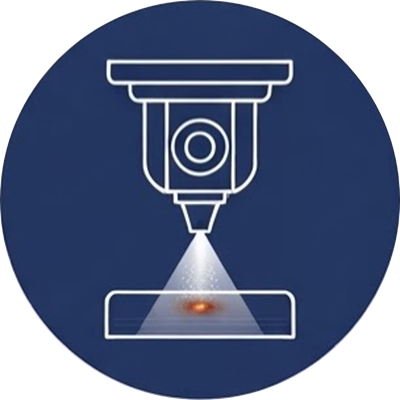
Through precision pan-and-tilt positioning, the system could more precisely locate where hazards occurred, allowing for targeted cooling or extinguishing and subsequently limiting the affected area.