


The Right Fit: Tailoring Embedded Platforms for Automated Workwear Management
Executive Summary
Across manufacturing, healthcare, and hospitality, companies rely on specialized workwear to enhance employee safety and prevent contamination in sensitive environments. However, when implemented at scale, companies may need to manage the inventory accuracy, availability, and distribution of thousands of garments across facilities, which presents a number of challenges.
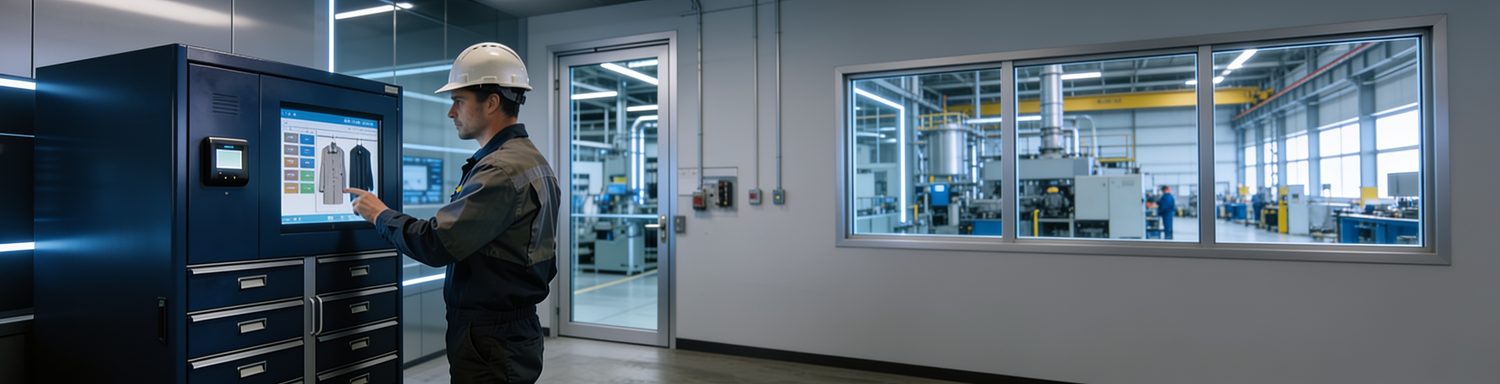
To address this, a multinational enterprise with a long track record of developing automated inventory solutions approached AAEON with their proposal for an automated garment dispensing unit. The goal was for the solution to automate the dispensing, tracking, and management of workwear to increase inventory accuracy and operational efficiency. To do this, they needed a platform that could act as both an edge controller and a human-machine interface (HMI) in one, ultimately choosing AAEON’s ACP-2076 Multi Touch Panel PC. Following successful market entry, the company saw uptake across hospitality, manufacturing, and healthcare sectors.
System Requirements
- A reliable, responsive, and intuitive display with performance that could cope with repeated, continuous use.
- The ability to interface with a number of unit subsystems, including motor controllers, RFID readers, and safety sensors.
- Secure connectivity to relay data to facility inventory management systems.
Key Platform Metrics: AAEON’s ACP-2076
By choosing the ACP-2076, the customer was able to consolidate all of the application’s necessary functions into one platform, rather than relying on a collection of components. In this sense, the ACP-2076 served as more than a panel PC, fulfilling simultaneous roles as an embedded controller, serial gateway, I/O module, and network interface all in one compact platform.
Projected Capacitive Multi-Touch Screen for Durable, Intuitive Use
The ACP-2076's 7-inch projected capacitive multi-touch display provided a clear, intuitive interface for end users. The PC’s IP65-rated front bezel also meant it could be deployed across different environments, offering more robust protection against water and dust ingress.
RFID-Based User Authentication
Through its USB ports, the PC could support RFID badge readers for user authentication and garment tracking. Meanwhile, the ACP-2076's RJ-45 ports offering 2.5GbE speeds meant it could relay dispensing data to facility cloud-based inventory management systems.
Synchronized Machine Component Control
With four DB-9 ports, each supporting RS-232/422/485, the ACP-2076 could directly interface with motor controllers to operate the unit’s dispensing drawers and cabinets. AAEON also customized the ACP-2076 to include an 8-bit DIO to allow immediate real-time safety signals to be received from the unit’s sensors.
Application Architecture
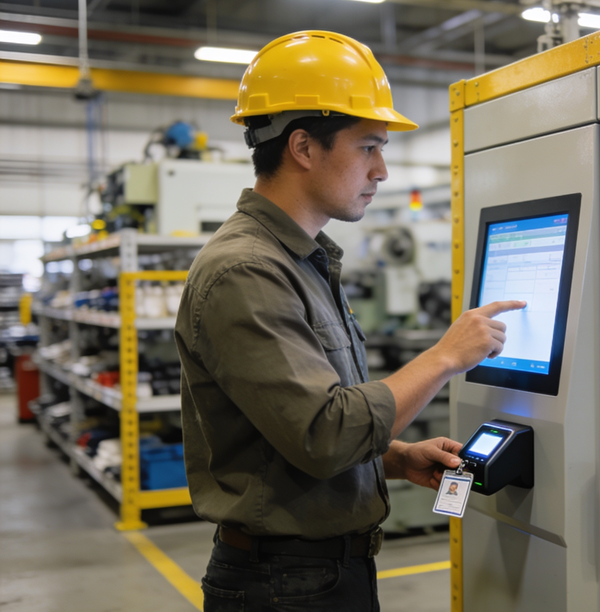
The architecture of the customer’s automated garment dispensing unit can be viewed through three key operational stages:
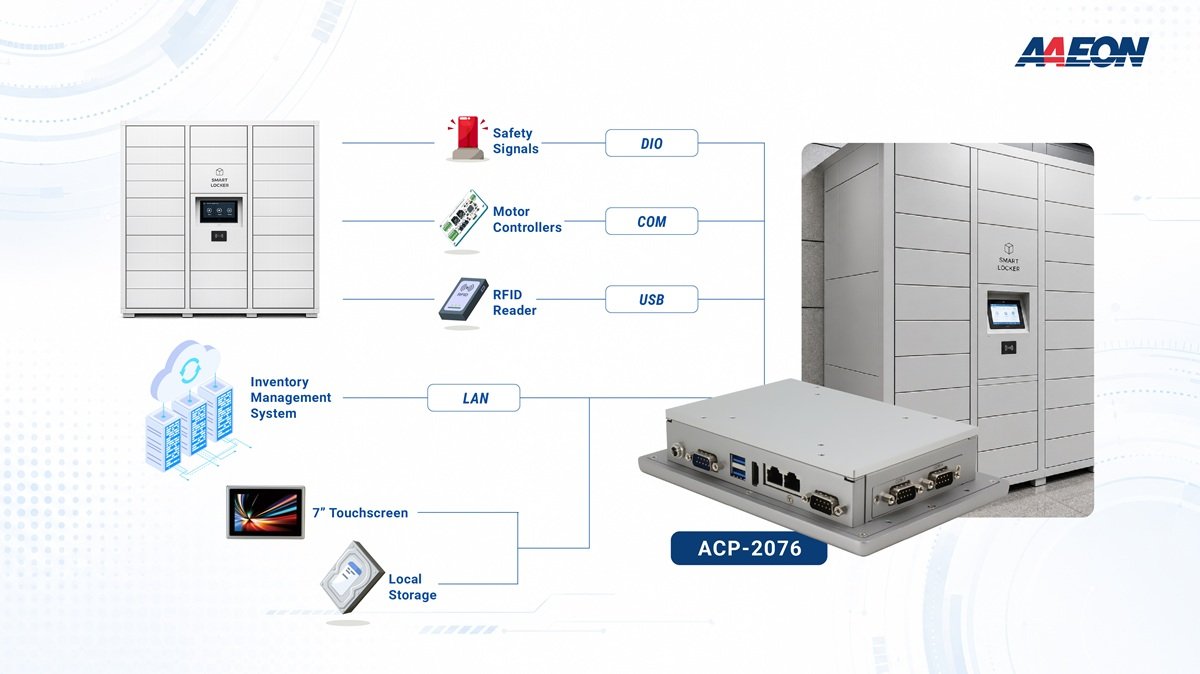
- Employees complete authentication by swiping their ID badge on an RFID reader connected to the ACP-2076's USB port, then use the PC’s integrated 7-inch projected capacitive touchscreen to select the garments they need.
- The unit’s motor controllers receive commands from the ACP-2076 via RS-485 signal provided by the PC’s DB-9 ports, with end-to-end dispensing operation including mechanical actuation being executed within an 8-10 second window.
- The transaction gets logged both locally on the ACP-2076's pre-installed SSD, and relayed to the facility’s cloud-based inventory management system over Ethernet.
Operational Insights Beyond a Workable System
While the features discussed show the ACP-2076 could make the customer’s application operational, they do not tell the whole story. For example, the PC’s embedded Intel® Processor N97 CPU not only came with a relatively conservative 12W TDP, but was augmented by AAEON’s BIOS-level power management policies. This enabled the CPU to go to power-saving mode when it was not being 100% utilized, reducing power draw while the unit was not in use.
From a practical standpoint, the customer also saw substantial benefit to working with AAEON, primarily with respect to ensuring its hardware was configured to meet their standards for longevity. The importance of this is best understood when considering the scale of the customer’s operations and the large number of units they intended to deploy.

While the ACP-2076 is designed for industrial environments, AAEON worked closely with the customer to evaluate its suitability where durability was concerned. Through extensive reliability verification, including accelerated lifecycle testing of the PC’s touch interface, the system demonstrated stable performance under prolonged operation.
Additional design refinements, such as enhanced environmental sealing and optimized front panel protection, were implemented to further improve long-term reliability, given the demanding conditions within which it needed to operate.
Implementation & Impact
With the ACP-2076, the customer avoided having to integrate multiple separate hardware components within their automated garment dispensing unit, instead saving both space within the unit and consolidating all functions into one system.
Adding to this practical consideration, the customer’s final product proved operationally effective in deployment. For example, in addition to reducing costs associated with lost garments by streamlining inventory management, the unit provided excellent value to their end users.
Based on customer-developed cost modeling, a facility with 300 employees could achieve estimated annual savings of approximately USD$9,810 through improved inventory control and reduced operational overhead. The model assumes a 300-employee facility, with each employee requiring two garments exchanged five times weekly, based on an average garment cost of USD$2 and laundry cost of USD$0.30 per item.
The success of the project drove the customer’s ambition to scale production, with annual orders exceeding 500 units as they expanded the presence of their solution across hospitality, manufacturing, and healthcare markets.
 苏公网安备 32059002002996号