


- Resources
- Tech Insights
- AI Inference Server Guide
What is an AI Inference Server?
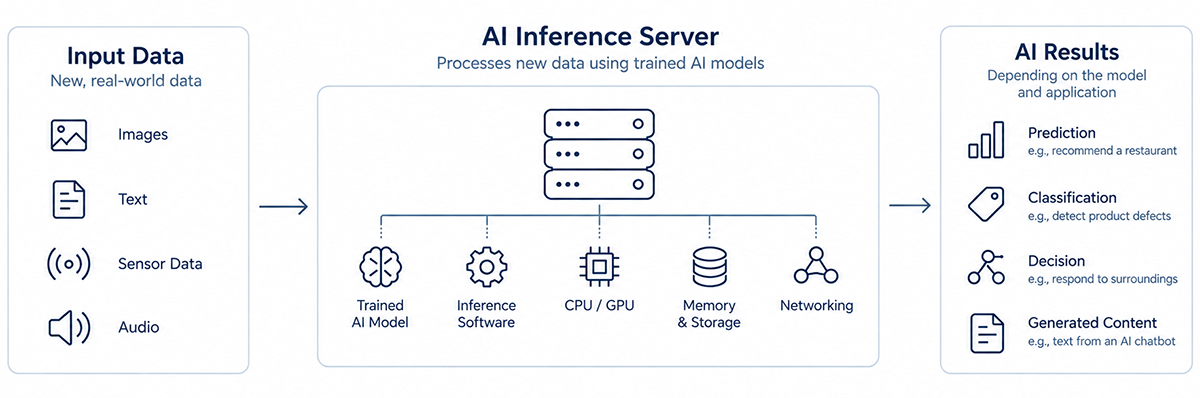
AI inference is the stage where a trained AI or machine learning model is put to work. Instead of learning patterns from training data, the model uses what it has already learned to process new input and produce an output. In other words, training builds the model, while inference applies it to real-world tasks.
The output depends on the type of model and application. An inference request might produce a prediction, such as recommending a restaurant; a classification, such as identifying a defect in a product image or detecting suspicious financial activity; a decision, such as helping an autonomous system respond to its surroundings; or generated content, such as text from an AI chatbot. Because inference is the stage users and applications interact with directly, its speed, reliability, and efficiency have a major effect on the overall AI experience.
An AI inference server is a computing system designed to run trained AI models and serve their outputs to applications, users, machines, or connected devices. It combines processing hardware, memory, storage, networking, and inference-serving software into a platform that can receive requests, execute the appropriate model, and return results. Unlike a general-purpose server, an AI inference server is typically configured around the specific models it needs to run and the environment in which it will operate.
Production inference also involves balancing several performance goals. Low latency is important when an application needs an immediate response, such as industrial vision, robotics, or an interactive AI assistant.
At the same time, the server may need high throughput to process many requests concurrently. Serving software can improve hardware utilization through techniques such as request batching and parallel model execution, helping accelerators spend more time performing useful inference work.
Scalability is another consideration when demand changes over time. Rather than relying only on conventional CPU or system-memory utilization, large inference deployments may use workload-specific indicators such as request queue length, concurrent requests, response latency, and available inference memory to determine when additional capacity is required.
AI Training Server vs. AI Inference Server
AI training and AI inference belong to different stages of the machine learning lifecycle, so the servers supporting them are optimized for different workloads.
An AI training server builds or updates a model by repeatedly processing training data and adjusting its parameters. Large training workloads can require substantial GPU compute, system memory, storage bandwidth, and communication between multiple accelerators. When training extends across several servers, high-bandwidth technologies such as Ethernet or InfiniBand help GPUs exchange data without creating major communication bottlenecks.
An AI inference server, by contrast, applies an existing model to new data. Inference generally requires fewer resources than training the same model from scratch, although the actual requirements vary considerably depending on model size, workload, concurrency, and response-time targets. For inference, the focus shifts toward delivering the required latency and throughput while using compute and memory resources efficiently.
| AI Training Server | AI Inference Server | |
| Main purpose | Build or update AI models | Run trained models on new inputs |
| Typical workload | Repeated computation over large training datasets | Live or batch inference requests |
| Main priorities | Compute capacity, memory bandwidth, and multi-GPU communication | Latency, throughput, concurrency, and efficiency |
| GPU requirements | Often multiple high-performance GPUs for large models | Varies from CPUs or individual accelerators to multi-GPU systems |
| Networking focus | High bandwidth for data transfer and distributed training | Low latency and sufficient bandwidth for incoming data and responses |
This difference does not mean inference hardware is always small or lightweight. Large language models, generative AI services, and high-volume computer vision systems can still require powerful multi-GPU inference servers. The appropriate configuration depends on the workload rather than simply whether the system is used for training or inference.
How Does an AI Inference Server Work?
An AI inference server acts as the bridge between an application and the trained model. Although the exact workflow varies by model and serving platform, a typical inference request moves through several stages:
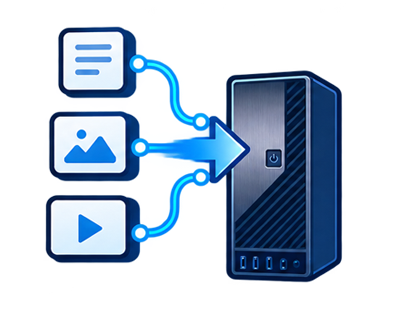
Input Request:
A client application sends new data to the inference server. The input may be a text prompt, image, video frame, audio stream, sensor reading, or another type of data.

Preprocessing:
The incoming data is converted into the format required by the model. For example, text used by a large language model is tokenized into numerical representations, while image data may be resized or normalized. These operations can be performed by the CPU, accelerator, or a combination of both depending on the application.
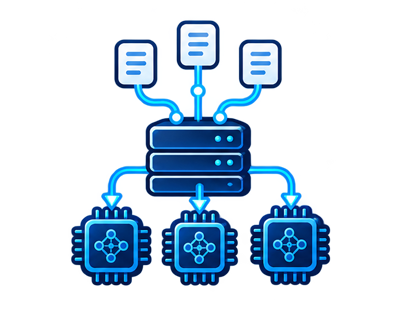
Request Scheduling:
The serving software routes the request to the appropriate model and available compute resources. Some inference engines can combine multiple requests into batches or execute several model instances concurrently to improve throughput and hardware utilization. For LLM serving, platforms such as vLLM also support continuous batching, where incoming requests can be scheduled dynamically rather than waiting for an entire fixed batch to finish.

Model Execution:
The processor or AI accelerator performs the calculations defined by the trained model and produces an inference result. Depending on the workload, execution may take place on a CPU, GPU, ASIC, NPU, or another specialized accelerator. For large language models, model weights and runtime data occupy accelerator memory, while a KV cache can store previously computed attention information to avoid repeating calculations during text generation.
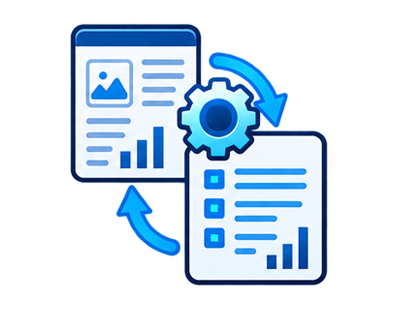
Post-processing:
The model's raw output is converted into a usable result. This could involve decoding generated tokens into text, converting scores into a classification, or formatting detected objects and coordinates for another application.
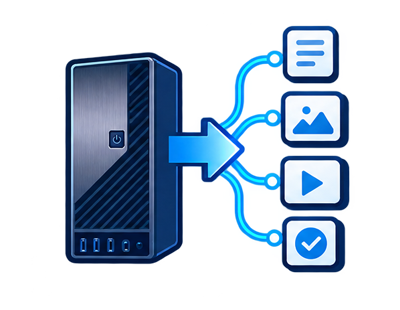
Output:
The server returns the final result to the requesting application, device, or system. Depending on the use case, this could be a chatbot response, an inspection result, a recommendation, an alert, or a control decision.
This entire process may take place within a single server or be distributed across several accelerators and systems for larger workloads. The hardware and software working behind this pipeline determine how quickly and efficiently the server can process inference requests, which is why the individual components of an AI inference server are so important.
Core Components of an AI Inference Server
The performance of an AI inference server depends on more than simply installing a powerful GPU. Processors, memory, storage, networking, software, power delivery, and cooling all need to work together without creating bottlenecks.
The right configuration depends on the model being served, the number of simultaneous requests, required response time, and where the server will be deployed. Below are the main components to consider and the role each one plays in production inference.
Processors and AI Accelerators (CPU and GPU)
The GPU or other AI accelerator performs most of the parallel mathematical operations required to execute demanding AI models. GPUs are particularly well suited to large language models, computer vision, generative AI, and multimodal workloads because they combine high parallel compute capability with high memory bandwidth.
CPUs remain important for coordinating the overall system and can handle application logic, data preparation, networking, storage operations, and other supporting tasks. Smaller or highly optimized models may also run directly on CPUs when GPU acceleration is unnecessary.
The right processor combination depends on the model type and size, numerical precision, latency requirements, and expected concurrency. A lightly loaded vision application may need only one accelerator, while a large LLM or high-volume inference service may require several GPUs. GPU memory capacity and bandwidth should be evaluated alongside raw compute performance because they can directly limit the models and workloads a GPU can support.
For multi-GPU systems, PCIe lane availability and topology should also be considered because they affect how efficiently data moves between CPUs, GPUs, and other components. High-bandwidth GPU interconnects such as NVLink and NVSwitch, where supported, can further improve communication between accelerators. The required interconnect depends on the GPU platform and whether the workload is divided across multiple GPUs or servers.
GPU Memory, System Memory, and Storage
Memory is another major factor in determining which models an inference server can run and how many requests it can process at once. GPU VRAM stores model weights and other data required during execution. For large language models, it can also hold the KV cache, which stores previously calculated attention information so that the model does not need to recompute the entire preceding sequence every time it generates another token.
As a rough starting point, model weight requirements can be estimated from the number of parameters and the number of bytes used to represent each parameter. Lower-precision formats and quantization can substantially reduce this requirement.
However, model weights are only part of the total memory footprint. Runtime overhead, activations, KV cache, framework requirements, batch size, and context length must also be considered, so available VRAM should not be sized from parameter count alone.
This becomes especially important when serving many users or long prompts because KV-cache requirements increase as more sequences and tokens remain active. Modern serving engines use memory-management techniques to make better use of available VRAM.
System memory, or RAM, supports the operating system, inference software, preprocessing, application services, and other CPU-side workloads. Some configurations may also use system memory for model loading, caching, or offloading portions of a workload when GPU memory is limited.
Storage determines how quickly models and related data can be loaded and accessed. High-speed NVMe SSDs are commonly used to store model files, containers, caches, logs, databases, and application data.
Storage performance becomes particularly important when models are frequently loaded or switched, when large datasets are accessed during inference, or when Retrieval-Augmented Generation (RAG) applications need to retrieve external information.
Once a model is loaded into GPU memory, however, inference performance is generally more dependent on compute resources, memory bandwidth, and available VRAM than on SSD speed alone.
High-Speed Networking
Networking connects the inference server with users, applications, cameras, sensors, databases, storage systems, and other computing nodes. Its importance depends greatly on the workload. Text requests may contain relatively little data, while multiple high-resolution video streams can continuously send substantial amounts of information to the server.
For a standalone inference server handling moderate request volumes, conventional Ethernet may be sufficient. Multi-camera vision systems, high-concurrency services, and distributed multi-server inference, however, may require 10, 25, 100 GbE or faster connectivity. High-performance network adapters can reach considerably higher speeds when required.
Network latency also needs to be considered when inference results need to reach an application quickly, particularly in edge environments where AI systems interact with machines or physical surroundings in real time.
The appropriate network configuration should be based on the number and type of connected devices, data volume, acceptable end-to-end latency, and whether inference is performed on one server or distributed across several nodes.
Inference Serving and Orchestration Software
Hardware provides the computing resources, while the inference serving software determines how efficiently those resources are used. This layer loads models, exposes APIs to applications, schedules incoming requests, manages model instances, and applies techniques such as batching to increase throughput.
Different serving platforms are optimized for different requirements.
- vLLM focuses on high-throughput serving of large language models and includes features such as PagedAttention, continuous batching, quantization, distributed inference, and OpenAI-compatible APIs.
- NVIDIA Triton Inference Server supports a broader range of AI frameworks and model types and provides features including concurrent model execution, dynamic batching, model pipelines, HTTP/REST and gRPC APIs, and performance metrics.
- SGLang is another production-oriented serving framework designed for low-latency, high-throughput large language and multimodal model inference, with features including continuous batching, prefix caching, multi-GPU parallelism, structured outputs, and tool calling.
It is also important to distinguish between different batching approaches. Triton's dynamic batching combines separate compatible requests into larger batches before model execution to improve throughput, while LLM-oriented engines such as vLLM support continuous batching, allowing the active workload to change as requests progress through generation.
When choosing the software stack, compatibility should be checked across the operating system, GPU drivers, accelerator libraries, container environment, AI framework, model format, and serving engine. Distributed or multi-GPU systems may require additional communication libraries and orchestration tools. Health monitoring, load balancing, autoscaling, and container orchestration can then be layered around the inference server as production requirements grow.
For larger deployments, orchestration software can manage multiple inference servers and containers, distribute workloads, monitor service health, restart failed instances, and scale resources as demand changes. Platforms such as Kubernetes can be combined with load balancing, monitoring, and autoscaling tools to support more resilient production deployments.
Power Supply
AI accelerators and modern server CPUs can consume substantial amounts of power, particularly when several are installed in the same chassis. Current high-end server CPUs can reach several hundred watts, while the NVIDIA L40S, for example, has a maximum power rating of 350 W. So, a multi-GPU inference system can impose a much greater electrical load than a conventional application server.
The power supply unit (PSU) must therefore be sized for the complete server rather than the GPUs alone. CPU, memory, storage, network adapters, motherboard components, and high-speed cooling fans all contribute to total consumption.
For production environments where downtime is costly, redundant hot-swappable PSUs can provide additional resilience if one power supply fails. High-density systems may also require appropriate rack power distribution, UPS (uninterruptible power supply) capacity, and facility-level electrical infrastructure. These requirements should be checked before deployment, particularly when several GPU servers will operate within the same rack or server room.
Cooling Systems
Higher computing density generates more heat. Continuous inference workloads can keep GPUs and CPUs under sustained load, causing them to consume significant power and generate heat over extended periods. Memory, storage, and power components also contribute to the overall thermal load.
Many server GPUs rely on chassis-level airflow rather than onboard fans. The NVIDIA L40S, for example, uses passive cooling and depends on the server's fans, heatsinks, air ducts, and component layout to remove heat. As a result, a GPU that physically fits a server is not necessarily thermally compatible with it.
Cooling becomes even more important when servers operate outside climate-controlled data centers. Edge inference systems deployed in factories, transportation systems, and other edge environments may need to handle higher ambient temperatures, dust, shock, or vibration. The complete server's thermal and environmental specifications should be considered rather than evaluating the GPU alone.
AI Inference Server Form Factors
AI inference servers come in different physical designs to suit different performance, space, and deployment requirements. Rackmount systems generally provide the greatest room for accelerators and expansion, while compact systems bring dedicated AI computing into locations where a full server rack is impractical. Industrial edge systems go a step further by adapting AI hardware for deployment near machines, cameras, sensors, and other sources of real-world data. Let’s learn more about these types:
Rackmount AI Inference Server
Rackmount AI inference servers are designed for installation in standard server racks and are commonly available in 1U, 2U, 4U, and larger configurations. They are particularly suitable for data centers and centralized server rooms where organizations need high computing density, centralized management, and room to scale inference capacity.
In general, a larger chassis provides more physical space for GPUs, expansion cards, storage, and supporting infrastructure, although the exact capacity depends on the individual server design. For example, some 1U systems support up to two double-width GPUs, while 2U platforms can support four. High-density 4U AI servers may accommodate eight or even more accelerators.
This expandability makes rackmount systems well suited to demanding workloads such as large-scale LLM serving, generative AI, centralized computer vision, and applications handling high numbers of simultaneous inference requests.
Larger systems can also provide more PCIe expansion and drive bays for high-speed storage and network adapters. Some 4U GPU platforms, for instance, combine eight GPUs with multiple NVMe drives and dedicated high-speed network expansion.
Compact AI Inference Server
A compact AI inference server packages dedicated inference computing into a much smaller enclosure, making it easier to deploy AI outside a conventional data center. Instead of occupying several rack units, these systems may sit in a control room, office, laboratory, healthcare facility, retail location, or other space where a full server rack would be unnecessary or impractical.
Their smaller size does not necessarily mean they are limited to lightweight workloads. The available performance varies widely according to the processor, accelerator, thermal design, and enclosure.
Compact servers are therefore useful for localized AI inference, where computing resources need to remain close to the applications they support. Possible uses include private AI assistants, local document retrieval, machine vision, smart infrastructure, healthcare applications, and aggregation of workloads from several nearby edge devices. Keeping inference locally can also reduce dependence on continuous access to remote cloud services when data privacy, connectivity, or response time is important.
Industrial and Edge AI Inference Server Systems
Edge AI inference describes where processing takes place rather than one specific server shape. An edge server runs AI closer to the source of the data, such as cameras, industrial equipment, vehicles, or sensors, instead of sending every request to a distant centralized data center.
For this reason, edge deployments can include several types of hardware, such as enterprise edge and industrial edge systems.
- Enterprise edge deployments may use conventional servers adapted for non-data-center locations such as retail or branch environments and are typically installed in relatively controlled conditions.
- Industrial edge systems, by comparison, are more likely to use ruggedized embedded computers or specialized enclosures designed for factory floors, telecom sites, vehicles, and other demanding environments.
Industrial systems may therefore emphasize features that are uncommon on traditional rack servers, including wide DC power input, wall mounting, industrial serial interfaces, CAN bus, PoE camera connections, cellular expansion, and compact fanless or ruggedized designs.
Depending on the application, they may also undergo testing for wider operating temperatures, shock, and vibration. For example, current industrial edge platforms can support multi-camera inference through independent PoE connections, while rugged systems may be validated against MIL-STD shock and vibration requirements.
Placing AI close to cameras and sensors also allows applications to process data locally and respond without first sending the information to a remote cloud service. This is particularly useful for applications such as industrial inspection, robotics, intelligent transportation, video analytics, and automated equipment, where decisions may need to be made quickly or connectivity cannot always be guaranteed.
Remote management becomes especially important when edge systems are spread across many locations. Centralized management platforms can help administrators deploy applications, monitor systems, and update distributed AI workloads without physically visiting every site.
Therefore, edge should be understood as a deployment architecture rather than a strict AI inference server form factor. A rackmount server in a regional facility, a compact server in a retail back office, and a rugged embedded computer beside a production line can all perform edge inference. The appropriate system depends on how close computing needs to be to the data source and the physical conditions in which the hardware must operate.
On-Premise AI Inference Servers vs. Cloud APIs
Organizations can run AI inference on infrastructure they control or access models through external cloud services. An on-premise AI inference server runs trained models on hardware owned or controlled by the organization, giving internal teams direct responsibility for the infrastructure and software stack. Cloud APIs, by contrast, provide access to externally hosted AI models over the internet, allowing organizations to use inference services without purchasing or maintaining the underlying servers.
| Factor | On-Premise AI Inference Server | Cloud APIs |
| API and operating costs | Requires upfront investment in hardware, but sustained workloads may become more cost-efficient over time when the system is well utilized. | Usually follows usage-based pricing, which lowers the initial barrier but can become costly as request volume grows. |
| Workload pattern | Better suited to stable, continuous, or high-volume inference workloads. | Well suited to testing, rapid deployment, and workloads with irregular or unpredictable demand. |
| Data privacy | Keeps data and models within infrastructure controlled by the organization, which can benefit sensitive or regulated applications. | Data is processed through the cloud provider and must follow its privacy, security, and compliance policies. |
| Latency | Local processing can reduce network-related delays and support applications that require predictable response times. | Performance may depend partly on internet connectivity, geographic distance, and cloud service conditions. |
| Model control | Provides greater freedom to choose models, serving frameworks, quantization methods, and hardware configurations. | Offers less control over the underlying infrastructure and available model options, but simplifies deployment. |
| Maintenance | Internal teams must manage hardware, software updates, cooling, power, security, and system availability. | The provider handles most infrastructure maintenance and platform management. |
In general, cloud APIs are attractive for fast deployment, experimentation, and workloads with variable demand, while an on-premise AI inference server provides greater control over infrastructure, data, models, and latency. For sustained and predictable workloads, owning the hardware may also make better economic sense over the long term.
Common Examples and Use Cases of AI Inference Servers
AI inference servers support a wide range of applications that need to process new data and quickly return predictions, classifications, decisions, or generated content. Common use cases can be grouped into several main categories:

Generative AI and Enterprise IT:
AI inference servers can host conversational chatbots, internal knowledge assistants, coding tools, document intelligence systems, and Retrieval-Augmented Generation (RAG) applications. They process user prompts, retrieve relevant company information, run the trained model, and return responses while keeping sensitive business data within controlled infrastructure when required.
Healthcare:
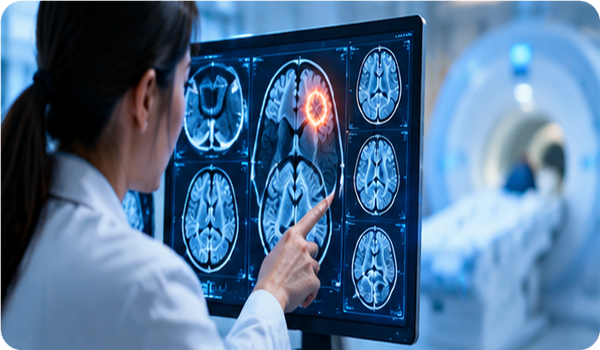
Hospitals and medical technology providers can use inference servers to analyze medical images, process patient monitoring signals, and support AI-assisted clinical workflows. Examples include detecting potentially abnormal findings in CT or MRI scans, analyzing physiological signals, and helping prioritize cases that may require closer review.

Automotive and Autonomous Systems:
Inference systems process camera, radar, LiDAR, and other sensor data to identify objects, recognize pedestrians and traffic signs, estimate road conditions, and support navigation or vehicle-control decisions. Many of these workloads require local or edge inference because responses such as braking or obstacle avoidance must occur with very low latency.
Industrial and Manufacturing:
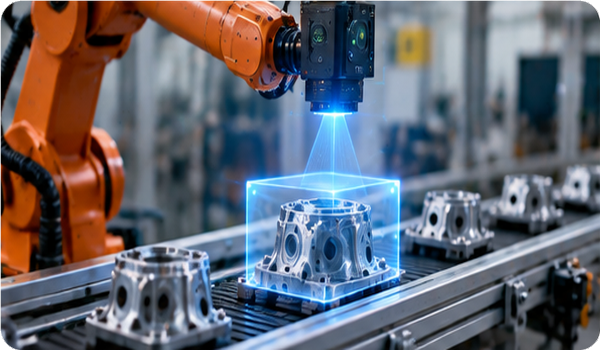
Factories can use AI inference servers for automated optical inspection, predictive monitoring, machine vision, robotics, and process control. For example, a server may analyze production-line camera feeds to identify defective products, monitor equipment data for abnormal operating patterns, or provide vision processing for robotic picking and sorting.

Finance and Banking:
Financial institutions can deploy inference systems for fraud detection, transaction monitoring, anomaly detection, risk analysis, and private customer-service AI. These systems may evaluate large volumes of transaction data in real time to identify unusual behavior while allowing sensitive customer and financial data to remain inside controlled infrastructure.

Smart Cities and Infrastructure:
AI inference servers can process data from traffic cameras, environmental sensors, surveillance systems, and connected infrastructure. Applications include traffic monitoring, crowd analysis, incident detection, infrastructure inspection, and automated alerts when unusual conditions are identified.
FAQs
| Does AI inference require a GPU? |
| No. Smaller or highly optimized models can run on CPUs, especially when latency and concurrency demands are low. However, GPUs and other AI accelerators are commonly used for larger workloads such as LLMs, computer vision, and multimodal AI because they provide much higher parallel processing performance and memory bandwidth. |
| What is the difference between AI training and AI inference? |
AI training is the process of teaching a model by adjusting its parameters based on large datasets. AI inference happens after training, when the completed model processes new data to generate predictions, classifications, decisions, or content. Training is generally more compute-intensive, while inference focuses more on response speed, throughput, and efficiency. |
| What is an edge AI inference server? |
An edge AI inference server runs trained AI models close to where data is generated, such as factories, stores, cameras, sensors, or transportation systems. Processing data locally can reduce latency, lower bandwidth requirements, improve data control, and allow some applications to continue operating even when cloud connectivity is limited. |
| Can an AI inference server run multiple AI models? |
| Yes. An AI inference server can host and run multiple models if it has sufficient compute, memory, and software support. Serving platforms can allocate resources across different models and process requests concurrently. Actual capacity depends on model size, GPU memory, workload intensity, and the number of simultaneous users. |
Find the Right Industrial AI Inference Server Solution at AAEON
At AAEON, we provide AI inference server solutions for a wide range of deployment needs, from rackmount infrastructure to compact industrial systems built for space-constrained environments. Our MAXER-5100 features an 8L tower design with support for dual NVIDIA RTX 2000 Ada GPUs, delivering powerful AI inference performance in a compact industrial-grade platform. Whether your application involves generative AI, machine vision, smart infrastructure, or industrial automation, AAEON helps you bring AI inference closer to where it is needed. Explore our solutions or contact our team to discuss your deployment requirements.


close
We’re just a message away! Let us help with your needs.
Get a Quote