- Resources
- Application Stories
- AI-driven Maritime Safety System
Executive Summary
According to the United Nations Conference on Trade and Development (UNCTAD), over 80 percent of goods worldwide are transported by sea, with commercial shipping flows servicing major markets typically concentrating around a select number of core routes. As a result, cargo vessels operate within a complex ecosystem that presents risks such as vessel collisions and navigational obstructions.
While existing methods exist to safeguard against such hazards, namely automatic identification system (AIS) and radar data, blind spots remain. For example, AIS relies on vessels exchanging position, speed, and navigational data, enhancing situational awareness and reducing uncertainty.
This being said, not all vessels are required to have AIS equipment on board. The International Maritime Organization’s International Convention for the Safety of Life at Sea states that AIS is mandatory for the following vessel categories:
- All passenger ships irrespective of size.
- All ships of 300 gross tonnage and upwards engaged on international voyages.
- Cargo ships of 500 gross tonnage and upwards not engaged on international voyages.
While relatively comprehensive, there are a number of vessel types that the convention does not account for, including smaller vessels such as fishing boats or certain non-commercial vessels. As such, cargo ships operating in congested lanes are not necessarily able to maintain complete awareness of them, which can lead to collisions.
Radar remains a useful tool for detecting potential navigational obstructions, and can be used to determine the presence of debris or other unknown objects, but it too has limits. One such limit is that radar performance degrades when presented with low radar cross section (RCS) objects, meaning objects like debris can be missed, especially in situations with poor visibility. Furthermore, the information radar can provide is limited. It can indicate the presence of an object, but is unable to provide context about what it might be, or how it behaves.
To address these gaps as part of a broader mission to increase maritime safety, one organization used AAEON’s BOXER-8658AI as an embedded safety decision node in their AI-driven safety system to better identify potential collision risks. Their high-level objective was not to replace the existing measures used by the international maritime ecosystem, but to give vessels a more precise view of their near-field environment where collision risk is highest.
System Requirements
- Support for multiple cameras capable of providing reliable, low-latency video data from multiple angles for AI analysis.
- A means of establishing precise vessel location, heading, and timestamping.
- Strong AI inference capabilities for real-time video analytics and automated decision-making.
- Rugged hardware for reliable operation aboard ships with limited space, high vibration, and variable temperatures and power supplies.
BOXER-8658AI Key Platform Metrics

Multi-PoE LAN Ports
Equipped with eight PoE LAN ports, the BOXER-8658AI could directly support the multiple high-resolution cameras used by the application, rather than relying on a PoE switch, as is common in more traditional setups. It may seem a small detail, but this was a major cost-saving factor informing the customer’s decision, as it allowed them to retrofit their existing IP cameras, reducing the need to redesign complex network infrastructure.
100 TOPS of AI Performance
Powered by the NVIDIA® Jetson Orin™ NX, the BOXER-8658AI offered the real-time AI computing power needed to simultaneously process data from connected high-resolution cameras, GNSS, and IMU modules. The system could then leverage the platform’s NVIDIA Ampere architecture GPU, capable of up to 100 TOPS of AI performance, to execute complex object detection, classification, and multi-object tracking models to identify collision risks with exceptionally low latency.
GNSS Support
The value proposition of the customer’s application was not to simply detect objects within the near-field environment, but to provide contextual data alongside its video feed for the system’s AI inference pipeline to determine collision risk. The BOXER-8658AI, supporting the integration of GNSS and IMU modules via a multifunction sensor interface header, enabled the ingestion of positioning, timing, and motion data. As such, the system could use this data to determine trajectory estimation and time-to-collision analysis.
Robust Hardware
Originally designed for demanding in-vehicle environments, the BOXER-8658AI was a natural fit for the customer’s application. the system’s military standard vibration and shock resistance ensured its critical components remained protected even under the stresses that it would encounter on board ships. The system’s -15°C to 60°C temperature range also allowed it to be deployed across regions with diverse climates. Finally, with a 9V to 36V power input range, the BOXER-8658AI was able to cope with variable power sources, ensuring stability.
From Platform Selection to Implementation
Having confirmed the BOXER-8658AI met the application’s key specifications, the next step was drawing up a plan to make it operational. As the customer would be retrofitting their existing high-definition IP cameras, hardware installation would be relatively straightforward. However, the customer noted that, given the scale of their fleet and the proprietary nature of their AI software stack, importing their software with adequate encryption would be a massive undertaking.
An NVMe module would need to be installed in the BOXER-8658AI’s M.2 2280 M-Key slot as storage for the customer’s AI model. However, the customer advised that importing all of the software components typically took between two and three hours per unit. At scale, this was not feasible.
Further, the customer expressed concerns around data protection and intellectual property security, given each unit would be installed on mobile, often remote vessels.
With flexible customization being a central facet of AAEON’s brand, these concerns were addressed in a way that was both scalable and cost-effective. To address the customer’s concerns about security, AAEON customized the BOXER-8658AI OS image to include full disk encryption. This acted as a safeguard against unauthorized access to proprietary software while the application was deployed.
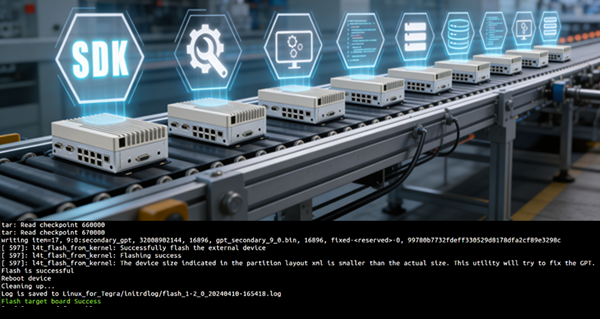
To shorten the time required to setup and import the software components needed by the application, AAEON integrated a cloning tool into the BOXER-8658AI’s manufacturing workflow. As a result, instead of the customer importing their software onto each unit individually, AAEON preinstalled it on the platform’s NVMe storage module as part of its production workflow. This significantly reduced on-site setup time while ensuring a secure, consistent deployment process across all units.
Application Overview
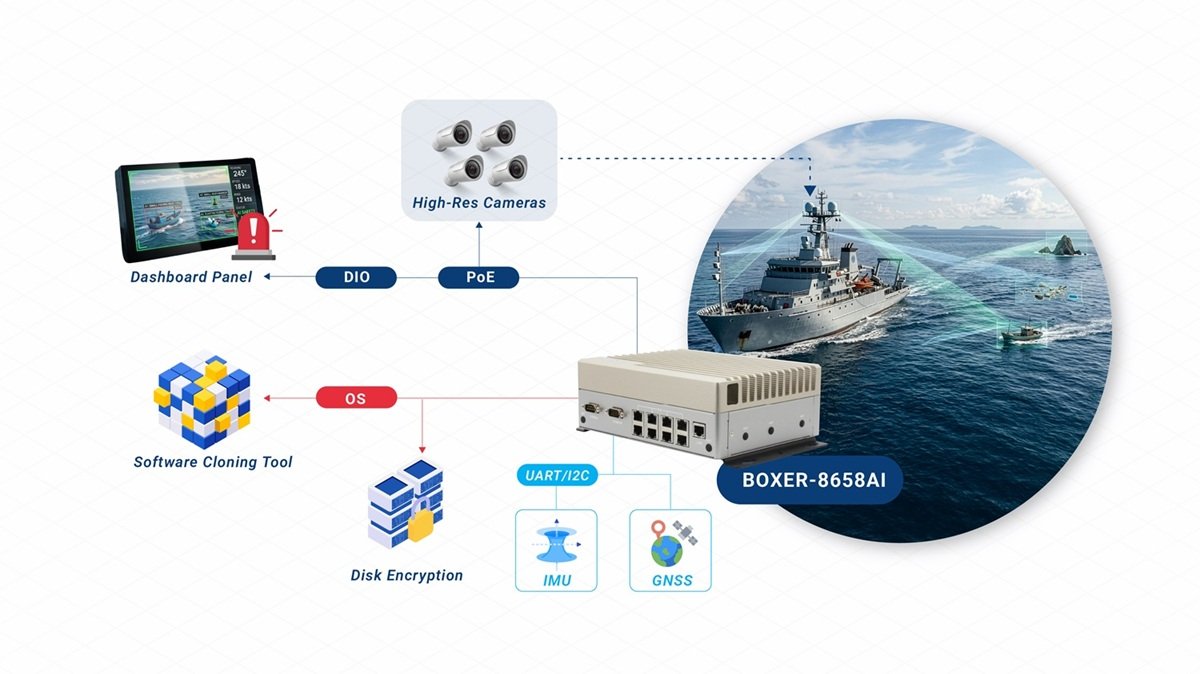
Through its connected IP cameras, the BOXER-8658AI received continuous real-time video feeds of a vessel’s near-field environment from multiple angles. Using its NVIDIA Jetson Orin NX module, the system could then decode and pre-process this data, allowing it to be analyzed by the customer’s object detection and classification models running on its GPU to ascertain the presence of nearby small boats, debris, or other obstacles.
In parallel, GNSS and IMU modules interfaced with the BOXER-8658AI via its sensor interface header, providing accurate ship position, heading, speed, and motion dynamics data. This second data stream was used to add context to the video intelligence being analyzed, allowing the models to estimate object trajectories and collision risk. In the event a hazard was identified, the alerts would be triggered through the BOXER-8658AI’s digital I/O to bridge displays, alarm panels, and buzzers.
Impact

Following a successful pilot run, the customer’s AI-driven safety system successfully entered mass production. Since then, they have built a geographically and commercially diverse client base for the solution. During more recent discussions with the company, they expressed great enthusiasm about the impact the system has had in such a short timeframe, noting that since going to market, the solution had identified over 100,000 instances of small vessels, debris, and other obstacles within vessel near-field environments.
In addition to the success of the project, the customer also highlighted their satisfaction with the way AAEON helped them during the implementation stage. Specifically, they estimated that approximately 2 to 3 hours of setup time per unit had been eliminated during field implementation as a result of software installation being incorporated into the BOXER-8658AI’s manufacturing workflow. With several hundred units now in operation, this represents substantial savings in both time and labor, allowing them to expedite product delivery.