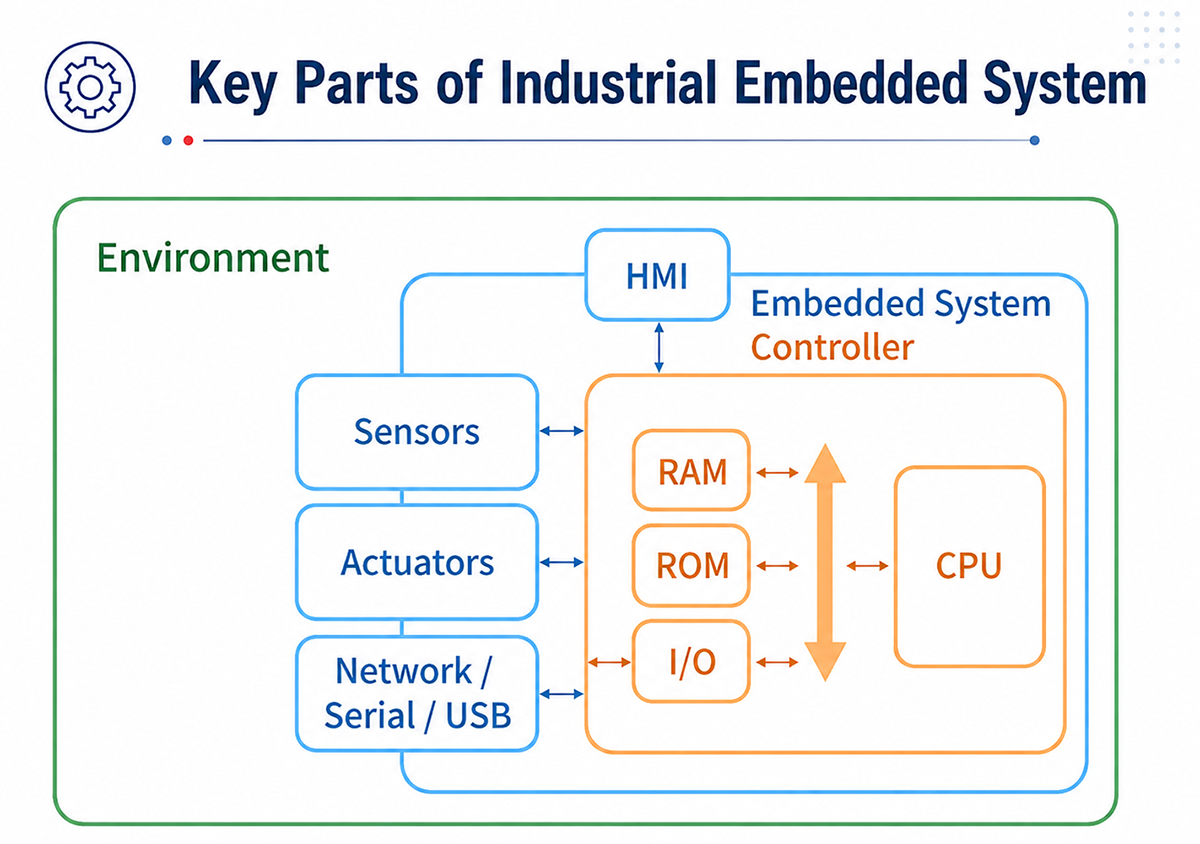
Successful industrial embedded systems design requires engineers to consider hardware and software together from the beginning. Processing performance, environmental protection, security, power consumption, and future expansion all affect one another.
The goal is not simply to build a system that works today, but to create one that remains reliable, maintainable, and secure throughout an industrial service life that may exceed ten years.
Operating Environment
The system must be designed for the conditions in which it will operate. Engineers should evaluate expected temperature ranges, humidity, dust, moisture, vibration, shock, and electromagnetic interference before selecting components and enclosures.
Software should also support the hardware by monitoring conditions such as temperature, voltage, and communication quality. It may reduce processor activity, trigger an alarm, or safely shut down equipment when operating limits are exceeded.
Performance Requirements
Designers must identify how much processing power the application needs and how quickly it must respond. A microcontroller may be sufficient for simple control tasks, while a more powerful processor or system-on-chip (SoC) may be needed for machine vision, advanced networking, data analytics, or a full operating system.
Timing requirements must also be clearly defined. Safety-critical controls may require hard real-time responses, while monitoring dashboards and data-logging functions may accept small delays.
Memory and storage capacity should account for the application software, operating system, data logs, communication functions, and future updates. Engineers should also prevent issues such as memory leaks from gradually reducing system stability.
Security
Industrial systems are increasingly connected to factory networks, cloud platforms, and remote management tools, making security an important design requirement.
Common protections include secure boot, encrypted communication, authenticated firmware updates, access control, and a hardware-based root of trust. Security should be built into the architecture rather than added after development, especially when the system controls important equipment or processes sensitive data.
Safety and Compliance
The system may need to meet industry-specific safety, cybersecurity, or electromagnetic compatibility requirements. Applicable standards depend on the product and intended market.
Examples include IEC 61508 for functional safety in industrial applications, ISO 26262 for automotive functional safety, and ISO/SAE 21434 for automotive cybersecurity. Identifying these requirements early can prevent expensive redesigns later in the development process.
Power Consumption and Efficiency
Power requirements affect component selection, heat generation, enclosure design, and operating costs. This is especially important for battery-powered, portable, or remotely installed systems.
Designers can improve efficiency by choosing low-power processors, disabling unused interfaces, placing inactive sensors into sleep modes, and optimizing software so tasks require fewer processing resources. Lower power use can also reduce heat, which may improve reliability and simplify cooling.
Scalability
A well-designed system should be able to support different product models, performance levels, or I/O configurations without requiring a complete redesign.
Hardware abstraction layers can separate application software from specific processors and components. This makes it easier to move the software to another platform, add new functions, or produce several product versions using the same core architecture.
Component Availability and Lifecycle
Industrial products often remain in service much longer than consumer electronics. Engineers must therefore consider whether processors, memory, connectors, and other components will remain available throughout the expected production and maintenance period.
The design should also allow alternative components to be used when parts become unavailable. Portable software, standardized interfaces, and modular hardware can reduce the cost and difficulty of future replacements.
Future Expansion
Industrial requirements may change as factories adopt additional sensors, faster networks, edge computing, and AI-based analysis. Designers should consider whether the system may eventually need more processing power, storage, communication interfaces, or remote-update capabilities.
Providing reasonable room for expansion can extend the product lifecycle. However, future-proofing should remain balanced with current cost, size, and power constraints rather than adding unnecessary hardware from the start.