


- Resources
- Application Stories
- MIX-ALND1 Intelligent Vending Solution

Executive Summary
As new technologies reshape retail, vending machine operators are increasingly adopting intelligent features to remain competitive with alternative retail models. For example, an estimated 8.1 million vending machines worldwide now offer some form of connectivity or telemetry function.
AAEON was approached by a leading vending solutions provider who, like many in the space, sought to adopt new technologies to make their machines more intuitive, easily maintained, and scalable for operators. Their vision was to bolster the benefits of unattended operation with remote monitoring capabilities, enhance customer experience, and enable its operators to scale product capacity through secondary dispensing units.
To achieve this, they chose AAEON's MIX-ALND1 Mini-ITX motherboard, which acted as a central computing platform to connect their vending application's software environment with the machine's physical and digital subsystems.
Key Application Requirements
- Store the vending operating system, run local application software, facilitate payment workflows, manage inventory, and process local data.
- Drive a large-format, intuitive touchscreen interface for product selection, pricing, product information, and purchasing.
- Provide a modular base that can be expanded to support secondary dispensing units without having to duplicate core computing or interface hardware.
- Interface with a variety of peripherals, including payment terminals, mobile wallet/QR code scanners, and receipt printers.
- Communicate with the machine’s control boards for temperature monitoring and binary machine-state signals such as product-drop sensors.
- Maintain reliable network connectivity for cloud-level inventory monitoring and remote diagnostics.
- Maintain an efficient power envelope during low-activity periods to reduce heat within the machine enclosure and prevent excessive power draw.
Creating a Centralized Vending Architecture
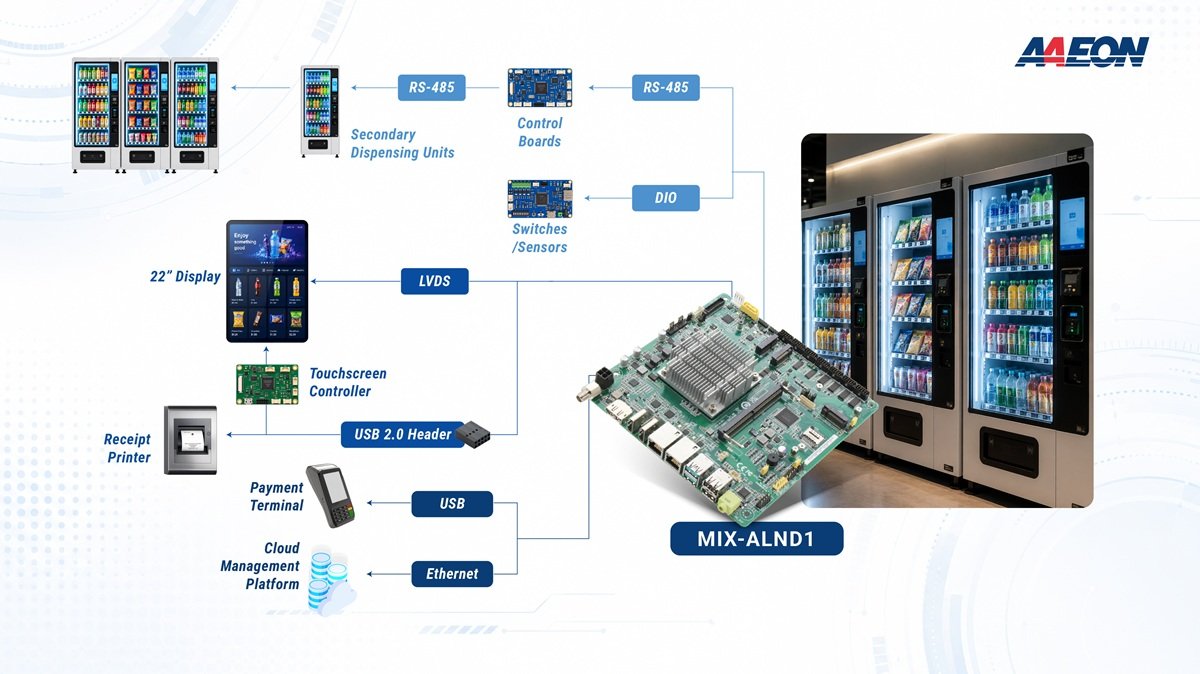
Where vending machines traditionally relied on rigidly programmed dedicated controllers, the customer wanted their vending solution to feature multiple application layers and functions. However, instead of replacing existing controller architecture, the customer employed the MIX-ALND1 to act as a high-level application and coordination platform connecting the vending software environment with the existing control hardware and digital subsystems used in vending solutions.
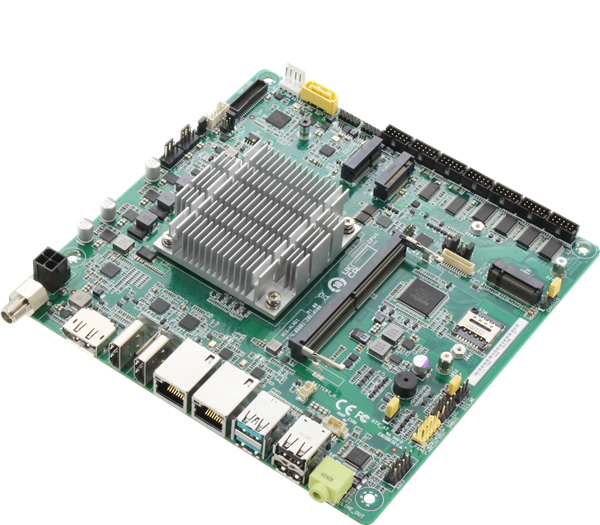
The MIX-ALND1 was well-equipped for such a role, hosting a range of interfaces able to communicate with dedicated control hardware as well as possessing the processing performance needed to execute application software.
Processing Power for Intelligent Vending
The MIX-ALND1 is available with a range of Intel Processor N-series CPUs. Given the processors are pin-to-pin compatible, the 8-core, 15W Intel Core i3-N305 Processor was selected for the application, as it offered the compute performance needed to run the vending machine’s application software and coordinate its key functions.
An Interactive, User-Friendly Interface
Driving the machine’s display panel was the MIX-ALND1's LVDS interface, with the panel’s touchscreen controller connected through one of the MIX-ALND1's 5-pin headers, which offered two USB 2.0 interfaces apiece. Meanwhile, the Intel Core i3-N305 Processor’s integrated Intel UHD Graphics handled UI rendering.
For the machine’s payment workflow, an integrated payment terminal module offering NFC, QR code, and card payment options was installed through a rear USB port. A receipt printer was connected to the same USB 2.0 pin header as the machine’s touchscreen controller.
Dedicated Control Hardware Communication
Equipped with six serial port headers, the MIX-ALND1 provided versatile communication channels for the solution’s dedicated control boards. With two of its headers offering BIOS-configurable RS-232/422/485 modes, higher-level machine control boards could be supported, with RS-485 offering a multidrop/control-bus connection.
Because of this, the customer could utilize its RS-485 connection to extend control to secondary dispensing units without deploying additional standalone machines, allowing operators to expand the vending solution in the event a particular deployment proved popular.
Remote Monitoring Through Cloud Connectivity
To monitor simpler, binary functions like door switches and product-drop sensors, the MIX-ALND1's 8-bit programmable DIO header was used, allowing it to continuously monitor operational states without relying on serial interfaces.
The board’s Gigabit Ethernet connectivity provided a route through which this information, as well as inventory, sales, and environmental data, could be relayed to the customer’s cloud-based management platforms, meaning operators could leverage intelligent features, but also monitor machines as part of larger fleet networks.
Application Architecture
Value Beyond System Functionality
While the MIX-ALND1 adequately handled both the compute and connectivity demands of the application, it also suited the operating profile of the vending solution, which had to remain powered and connected 24/7 with most intensive computing activity occurring during customer transactions.
AAEON’s compatibility testing showed that during full-system load testing (CPU, 16GB of RAM, 128GB of storage, a Windows OS, and I/O hosting dummy loads), the MIX-ALND1's power consumption peaked at 68W, with steady-state consumption being 48W.
Because the vending solution would spend much of its time in lower-workload states between customer transactions, the board's low-workload power draw was particularly relevant. Testing showed that when subjected to a sustained, processor-heavy workload, the MIX-ALND1 consumed 22.8W, while in idle mode (CPU utilization maintained at ≤3%) it consumed just 11W.
In practice, many functions would need to run continuously, meaning the full machine’s idle power draw was likely higher than AAEON’s board-level figures. The MIX-ALND1's power draw under low-workload conditions can nonetheless be used as a useful reference for periods during which the machine was operational, but not actively processing customer transactions.
Business Impact
24/7 Operation
For smaller operations, the solution offered a way to continue serving customers outside of regular business hours without the costs associated with bringing in additional staff.
Enhanced Customer Experience

With its user-friendly touchscreen interface and flexible payment options, the end product offered end users a more informative and interactive shopping experience than conventional vending solutions.
Measurable Commercial Value

The customer reported that a retailer deploying the vending solution achieved a 20% increase in profit during its first year of operation, highlighting the potential value of intelligent, scalable vending solutions.
Simplified Scalability
Secondary dispensing units enabled product capacity to be expanded in locations where products frequently sold out without deploying additional standalone machines, allowing operators to build on successful deployments using the same core architecture.
Data-Driven Management

By collecting and transmitting sales and inventory data, the solution allows operators to measure the popularity of particular products. As such, product allocation can be adapted to reflect purchasing demand.
Proactive Maintenance

With the MIX-ALND1's Ethernet-based connectivity with cloud management platforms, operators can improve maintenance planning. For example, personnel can prioritize machines requiring attention, reducing unnecessary site visits while shortening response times when problems occur.
With its efficient processing base, reliable wired networking, and an I/O designed to communicate with diverse subsystems, the MIX-ALND1 showed itself to be a strong base upon which to build intelligent vending solutions. Acting as an edge coordination platform, the board allowed the customer to add an intelligent application layer to an existing vending architecture without replacing the dedicated control hardware underneath it, while providing the connectivity and expansion needed to scale the system.






close
We’re just a message away! Let us help with your needs.
Get a Quote