


- Resources
- Tech Insights
- Physical AI Computer Guide
What is a Physical AI?
Physical AI refers to artificial intelligence that can perceive and understand the physical world, make decisions based on what it observes, and translate those decisions into real-world actions. Instead of working only with digital inputs such as text or images, physical AI operates through machines such as robots, autonomous mobile robots (AMRs), vehicles, and intelligent industrial equipment.
A physical AI computer provides the computing power that connects this intelligence to the machine itself. It receives information from cameras, LiDAR, radar, force sensors, encoders, and other sensors, processes that data through AI models, and works with control software to determine what the machine should do next. The resulting commands can then be sent to motors, robotic arms, grippers, steering systems, or other actuators.
The importance of physical AI lies in its ability to make machines more adaptive. Conventional automated systems generally follow predefined rules and operate best in predictable conditions. Physical AI systems can interpret changing environments and adjust their behavior accordingly.
This ability is expanding automation beyond repetitive tasks toward robots and machines that can operate more independently in factories, warehouses, transportation, healthcare, and other complex environments.
Key Functions of Physical AI
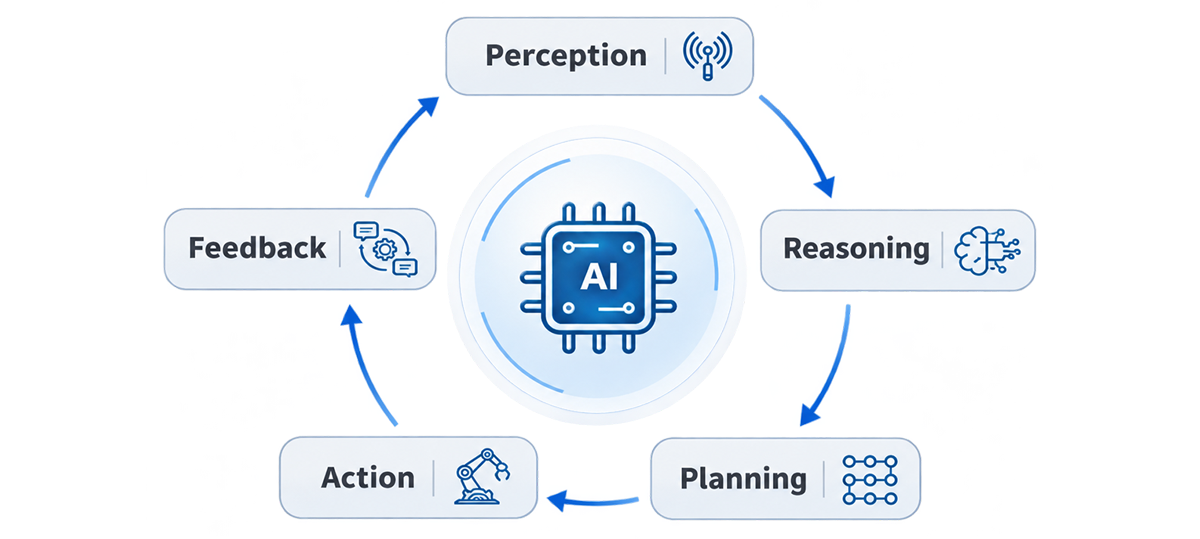
For a physical AI computer, real-world operation can be understood as a continuous perception → reasoning → planning → action → feedback cycle. Each stage turns information from the environment into increasingly useful instructions for the machine.
1.Perception: The process begins with sensors gathering information about the machine and its surroundings. Cameras may capture objects and people, while LiDAR and radar measure distance and movement. Other devices, such as IMUs, force sensors, encoders, microphones, or temperature sensors, can provide information about position, motion, contact, or environmental conditions.
2.Understanding and Reasoning: The physical AI computer processes these inputs to determine what is happening around the machine. AI models may identify objects, estimate their position, interpret spatial relationships, recognize abnormal situations, or understand instructions. Physical AI can also combine information from several sensor types to build a more complete picture of the environment.
3.Planning: Once the system understands the situation, it determines what should happen next. A warehouse robot might calculate a new path around an obstacle, while a robotic arm may determine how to approach and grasp an object. Planning converts the AI system's interpretation of the environment into a practical sequence of movements or decisions.
4.Physical Action: The computer then sends control instructions to the machine. Depending on the application, these outputs may control wheels, motors, steering systems, joints, robotic grippers, pumps, valves, or other actuators. This is the point where an AI decision becomes a physical action.
5.Continuous Feedback: Sensors continue monitoring what happens after the action is taken. If the environment changes or the movement does not produce the expected result, the new sensor data is processed again and the system can adjust its next action. This closed-loop operation is what allows physical AI systems to respond continuously rather than simply execute a fixed series of commands.
The 3 Core Computing Layers
Building a physical AI system requires more computing power than the computer installed inside the final machine. The development process can be divided into three main computing layers: training, simulation, and edge inference and control.
Each layer has a different role. Powerful data-center systems train AI models, simulation platforms test them in virtual environments, and the physical AI computer runs the optimized models on the real machine. NVIDIA uses a similar three-computer architecture covering training, simulation and synthetic data generation, and runtime computing.
The 3 Core Computing Layers
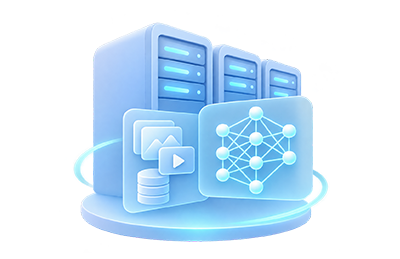
Training
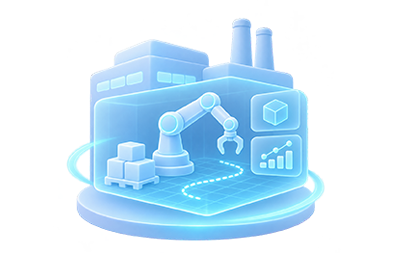
Simulation
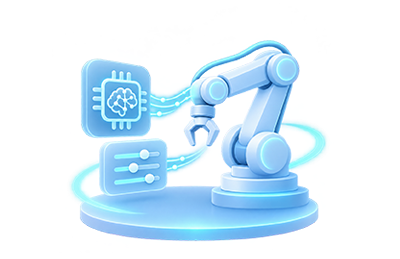
Edge inference and control
Training
The training layer is where physical AI models learn the capabilities they need for real-world tasks. High-performance computing systems process large datasets containing images, videos, sensor data, demonstrations, synthetic data, and other information.
Depending on the application, models may learn to recognize objects, understand their surroundings, interpret instructions, predict movement, or choose appropriate actions. Training can require far more computing power than running a finished model because the system must repeatedly adjust the model using large amounts of data.
For this reason, training is usually performed on GPU-accelerated servers or AI supercomputing systems rather than on the compact computer installed inside a robot. After training, the model can be optimized and prepared for simulation, validation, and deployment.
Simulation
Real machines cannot safely or efficiently experience every possible situation during development. Collecting large amounts of real-world robot data can also be expensive, time-consuming, or even dangerous, especially when developers need to test collisions or other rare situations.
The simulation layer helps address these challenges by creating virtual versions of robots, sensors, machines, and their environments. Developers can use these virtual environments to generate synthetic data, test robot behavior, evaluate control strategies, and expose AI models to a wider range of conditions without risking physical equipment.
Digital twins can represent environments such as factories and warehouses, while physics simulation can model movement, contact, gravity, and collisions. Developers can also change factors such as lighting, object positions, and textures to help models perform reliably in different environments.
Edge Inference and Control
The edge inference and control layer is where the physical AI computer directly supports the machine's real-world operation. After a model has been trained and validated, an optimized version is deployed on a computer installed inside or close to a robot, vehicle, industrial machine, or other autonomous system.
Unlike the training system, the edge computer does not need to train a large AI model. Instead, it runs trained models while processing live data from the machine. It may handle multiple camera feeds, combine information from different sensors, run perception and reasoning models, calculate actions, and communicate with controllers and actuators.
Local processing is important because physical AI systems cannot always rely on a remote cloud server for time-sensitive decisions. Processing data close to the machine can reduce communication delays and allow critical functions to continue even when network connectivity is limited.
The physical AI computer therefore needs to balance AI performance with practical requirements such as power consumption, thermal management, system size, sensor connectivity, networking, and reliability. Depending on the application, it may combine CPUs with GPUs or other AI accelerators to handle general computing and AI workloads.
Of the three computing layers, the runtime edge layer is the one most directly associated with the physical AI computer deployed in an autonomous machine. The next section looks more closely at the hardware required to build one.
What Hardware Does a Physical AI Computer Need?
A physical AI system has to process large amounts of sensor data, run AI models, make decisions, and communicate with physical equipment in near real time. To support these tasks, physical AI computer hardware usually combines several types of processors with high-speed memory, storage, sensor interfaces, networking, and control I/O.
The exact configuration depends on the machine. A compact AMR, for example, has very different power and space requirements from an industrial robot or autonomous vehicle. However, most physical AI computers share the following hardware elements:
CPU and AI Accelerators
The CPU remains responsible for general computing tasks such as operating-system functions, application logic, communication, and coordination between different workloads. Physical AI, however, usually requires additional processors because AI inference and sensor processing can be too computationally intensive for the CPU alone.
GPUs are particularly important because their parallel architecture is well suited to computer vision, transformer models, and other AI workloads. Some platforms also include dedicated AI accelerators such as NPUs or deep-learning accelerators to execute specific neural-network operations more efficiently.
Modern edge platforms increasingly integrate several of these processing engines into a System-on-Chip (SoC). NVIDIA Jetson AGX Orin, for example, combines an Arm CPU, NVIDIA GPU, deep-learning accelerators, and vision acceleration in one embedded platform.
Newer platforms are designed for even larger physical AI models. NVIDIA Jetson AGX Thor combines a 14-core Arm Neoverse CPU with a NVIDIA Blackwell architecture GPU and 128 GB of LPDDR5X memory, targeting advanced robotics and other autonomous systems.
Memory and Storage
Physical AI applications frequently process several data streams at the same time. Multiple cameras may be generating images while LiDAR, motion sensors, and other devices continuously produce additional data. Meanwhile, AI models and application software must remain readily accessible to the processors.
Sufficient memory capacity and bandwidth are therefore important for keeping these workloads running efficiently. Larger multimodal and vision-language-action models can also increase memory requirements substantially.
Storage is needed for the operating system, AI models, application software, maps, logs, and locally recorded sensor data. High-speed NVMe SSDs are commonly useful when applications need to load large models or continuously record high-volume data.
For example, NVIDIA Jetson AGX Orin supports LPDDR5 memory and external NVMe storage, while NVIDIA Jetson AGX Thor provides 128 GB of LPDDR5X memory and NVMe storage support.
Sensor Connectivity
A physical AI computer must have the interfaces required to receive information from the sensors surrounding the machine. Depending on the application, these may include RGB and depth cameras, LiDAR, radar, IMUs, encoders, force sensors, microphones, or positioning systems.
Camera-heavy applications may require interfaces such as MIPI CSI-2, USB, GigE, or Power over Ethernet (PoE), while other sensors can connect through CAN, serial ports, GPIO, or dedicated expansion interfaces.
The number and bandwidth of these connections matter. A robot processing several high-resolution camera streams simultaneously, for instance, requires much more data throughput than a machine relying on a few low-bandwidth sensors.
Networking and Control Interfaces
Physical AI computers also need to communicate with the rest of the machine and, in many cases, with other systems around it.
High-speed Ethernet can transfer camera data or connect the computer to other computing nodes, while Wi-Fi and 5G may provide wireless communication with fleet-management systems or cloud services. Industrial interfaces such as CAN, CAN FD, RS-232/422/485, and digital I/O are commonly used to communicate with controllers, sensors, and other equipment.
These connections also provide the bridge between AI decisions and physical action. Once the computer determines what the machine should do, instructions can be passed through the appropriate control system to motors, robotic joints, grippers, steering mechanisms, valves, or other actuators.
Power, Cooling, and Physical Design
Raw AI performance is only one consideration when choosing a physical AI computer. The system also has to fit within the power, thermal, and mechanical limits of the machine in which it operates.
Mobile robots are particularly sensitive to power consumption because higher computing demand can reduce battery operating time. More powerful processors also generate more heat, making thermal design an important factor when a system must operate continuously inside a compact enclosure.
Industrial deployments may introduce additional requirements such as wide operating temperatures, resistance to vibration and shock, stable DC power input, or fanless cooling. These features are application-dependent rather than requirements of physical AI itself, but they become important when the computer is deployed on factory equipment, vehicles, AMRs, and other machines operating outside a controlled data-center environment.
Ultimately, the goal of choosing the right physical AI computer hardware is not simply to select the fastest processor, but to build a computing platform capable of supporting the complete machine reliably in its intended operating environment.
Examples of Physical AI Computers
Physical AI computers can be deployed wherever machines need to interpret their surroundings and respond through physical movement or control. Depending on the application, the computer may be embedded directly inside a robot or vehicle or installed nearby as an industrial computer for physical AI processing.
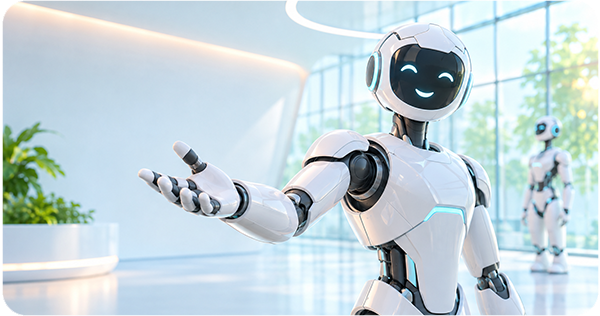
Humanoid Robots
Humanoid robots are one of the most advanced applications of physical AI. Their human-like structure allows them to work in environments originally designed for people, but it also requires substantial computing power for vision, navigation, balance, manipulation, and reasoning.
A physical AI computer for robotics can process multiple cameras and sensors while running models that help a humanoid recognize objects, understand instructions, plan movements, and control its joints. These capabilities are being developed for manufacturing, material handling, logistics, research, and service applications.
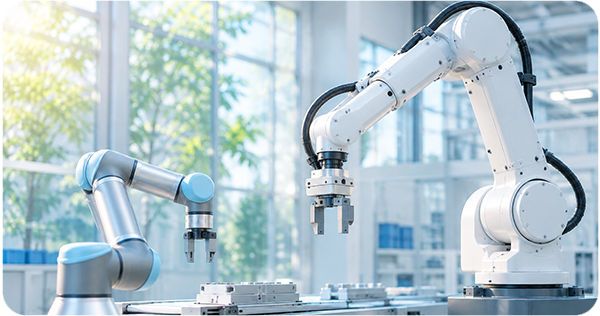
Collaborative and Industrial Robots
Industrial robotic arms traditionally perform predefined movements repeatedly within highly controlled work areas. Adding physical AI can make these systems more adaptable to changing objects, positions, and production conditions.
A vision-enabled physical AI robot, for example, can identify the position and orientation of different components on a conveyor and adjust its movement before picking them up. Similar capabilities can support assembly, sorting, machine tending, welding, and other manufacturing processes where greater flexibility is required.
Collaborative robots can also use cameras and other sensors to better understand their surroundings when operating close to human workers.
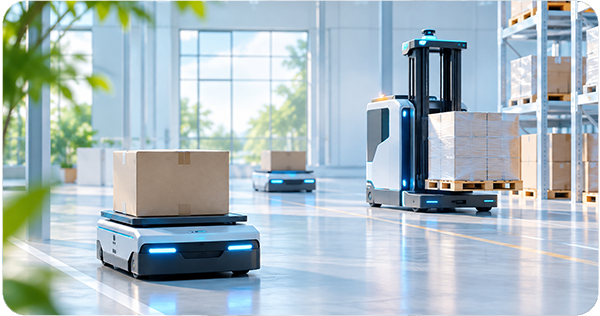
AMRs, AGVs, and Autonomous Forklifts
Autonomous mobile robots (AMRs) are widely used in warehouses, factories, and logistics facilities to move materials without constant human control.
Unlike conventional AGVs that may depend heavily on fixed routes or guidance infrastructure, AMRs can use cameras, LiDAR, localization data, and onboard computing to map their surroundings and adjust routes as conditions change.
The physical AI computer processes this information locally to detect obstacles, calculate paths, and support motion control. Similar technology can be applied to autonomous forklifts, delivery robots, and other mobile equipment that must navigate dynamic spaces shared with people and machines.
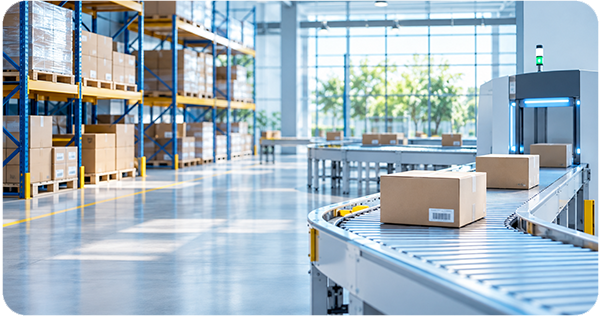
Smart Warehouses and Automated Factories
Physical AI can also operate at a larger facility level. Smart factories and warehouses may combine fixed cameras, mobile robots, robotic arms, autonomous vehicles, and other intelligent equipment into a connected automation environment.
An industrial computer for physical AI can process machine-vision feeds, monitor production equipment, identify anomalies, or provide edge inference for robotic systems. At the same time, fleets of autonomous machines can coordinate material movement and respond to changing production requirements.
Physical AI is increasingly being connected with industrial digital twins as well. Companies including Foxconn are using physical AI tools for industrial simulation and development workflows before deploying systems into real facilities.
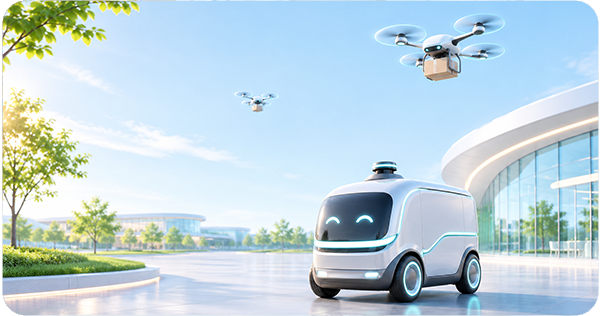
Autonomous Vehicles and Drones
Autonomous vehicles are another major example because they must continuously interpret rapidly changing physical environments while moving.
Cars, agricultural machinery, and other autonomous vehicles can combine cameras, radar, LiDAR, positioning systems, and onboard AI computing to detect objects, understand road or terrain conditions, and determine appropriate steering, braking, and acceleration.
Drones use similar principles in three-dimensional environments. Physical AI can help them plan routes, avoid obstacles, inspect infrastructure, map terrain, or complete missions with less dependence on direct remote control.
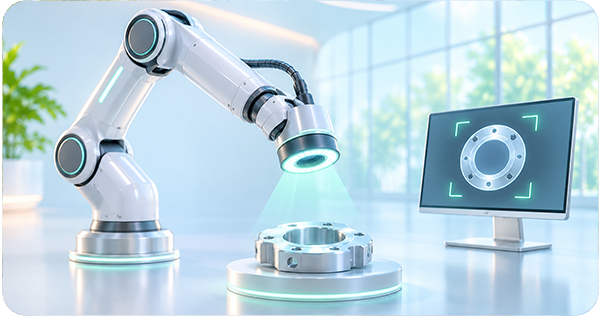
Machine Vision and Robotic Inspection
Physical AI can extend conventional machine vision beyond simply identifying a defect and producing an alert.
A vision system may detect an incorrectly positioned component and provide information that allows a robot to remove or reposition it automatically. Mobile robots and drones can similarly inspect pipelines, power infrastructure, manufacturing equipment, or other locations that are difficult or dangerous for people to access.
These applications combine visual AI with physical movement and control, allowing inspection systems not only to observe their environments but also to respond to what they detect.
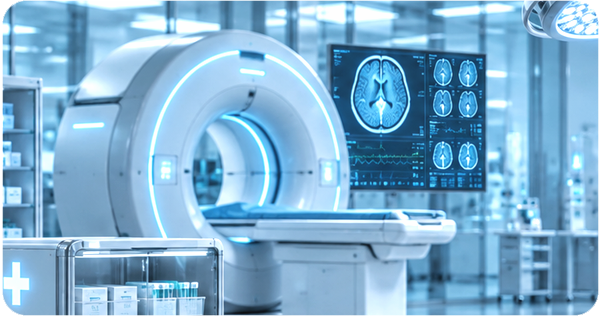
Healthcare and Medical Robots
Physical AI computers are also being explored in medical and healthcare systems where precise sensing and movement are essential. Robotic surgical platforms can combine imaging, positioning, and control technologies to assist clinicians with highly precise procedures. Autonomous mobile robots can navigate hospitals to transport medication, equipment, meals, or supplies between departments.
Common Challenges of Developing Physical AI
Developing physical AI is more difficult than building purely digital AI because the system must operate reliably in an unpredictable physical environment. Key challenges include:
Limited Real-World Data:
Physical AI training requires robots or machines to interact with real objects and environments. Collecting this data is expensive, slow, labor-intensive, and difficult to scale compared with using large online datasets.
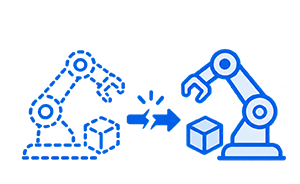
The Sim-to-Real Gap:
Simulation helps generate synthetic data and test behavior safely, but virtual environments cannot perfectly reproduce real-world conditions. A model that performs well in simulation may still struggle after deployment.
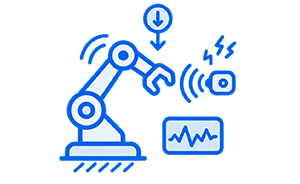
Complex Physics and Sensor Noise:
Physical systems must account for friction, gravity, motion, surface conditions, temperature, wear, and other variables. Sensors can also produce noisy or imperfect data that affects perception and decision-making.
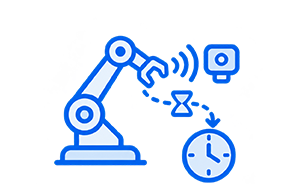
Latency and Response Time:
Physical AI depends on fast communication between sensors, computing hardware, control systems, and actuators. Excessive delay can reduce accuracy or create safety risks, especially in robots, vehicles, and high-speed machinery.
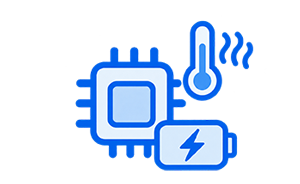
Compute, Power, and Thermal Limits:
Advanced vision and multimodal models require substantial processing power. For mobile systems such as AMRs and humanoid robots, developers must balance AI performance with battery life, heat dissipation, size, and weight.
Safety and Reliability:
Errors in physical AI can cause equipment damage or injury rather than just an incorrect digital output. Systems therefore require extensive testing, fail-safe mechanisms, and reliable control before real-world deployment.
Slower Hardware Development Cycles:
Software can be updated quickly, but sensors, motors, actuators, and other hardware components evolve more slowly. Hardware redesign, manufacturing, testing, and certification can significantly extend development timelines.
FAQs
What hardware is needed for a physical AI computer? |
A physical AI computer typically requires a CPU, GPU or other AI accelerator, high-speed memory, storage, sensor interfaces, networking, and industrial control I/O. The exact configuration depends on the application, including its AI workload, number of sensors, power limits, and operating environment. |
Why is edge computing important for physical AI? |
Edge computing allows physical AI systems to process sensor data and make decisions close to the machine instead of relying entirely on the cloud. This helps reduce latency, lowers network dependency, and supports faster responses for robots, autonomous vehicles, and industrial equipment. |
What are common applications of physical AI? |
Physical AI is used in humanoid robots, industrial and collaborative robots, AMRs, autonomous forklifts, smart factories, autonomous vehicles, drones, machine vision systems, robotic inspection, and healthcare robots. These applications combine AI processing with sensors and physical control. |
Can industrial computers be used for physical AI? |
Yes. Industrial computers can serve as physical AI edge platforms when they provide sufficient AI processing performance, sensor connectivity, networking, and control interfaces. Rugged designs, wide operating temperatures, fanless cooling, and resistance to shock or vibration can also be important for industrial deployments. |
Power Up Your Physical AI Systems with AAEON
Bringing physical AI into real-world environments requires edge hardware that can combine high AI performance with reliable sensor connectivity and industrial deployment features. AAEON’s BOXER-8741AI, powered by NVIDIA Jetson T5000, is built for advanced robotics and multi-sensor applications, while the fanless BOXER-8742AI with Jetson T4000 targets applications such as smart factory automation and AMRs.
Whether you are developing humanoid robots, autonomous machines, or industrial AI systems, we provide edge computing platforms designed to move physical AI from development into deployment. Contact AAEON to discuss the right solution for your application.


close
We’re just a message away! Let us help with your needs.
Get a Quote