


On the Go: Powering Battery-Swapping Station Expansion with the SRG-IMX8P
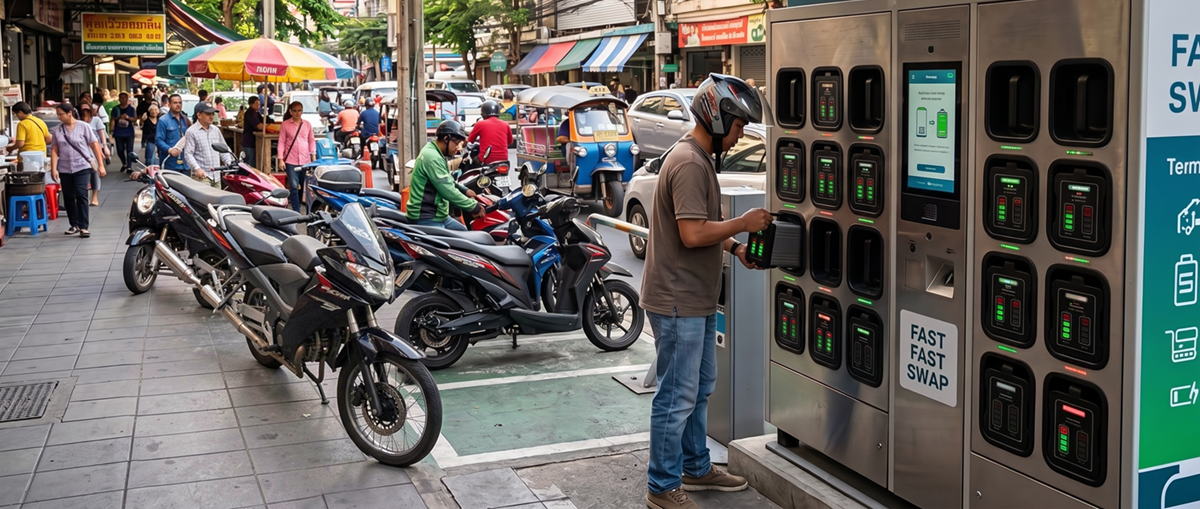
Electromobility has dramatically accelerated in recent years, with electric cars representing an estimated 25% of global car sales in 2025, a substantial jump from just 4% in 2020. Similar growth can be seen in worldwide motorcycle and scooter fleets, where almost 15% of such vehicles sold in 2025 were electric, resulting in approximately one in ten two-wheelers globally now being electric-powered.
This trend is especially visible in markets where two-wheelers are already an established mainstream option for both everyday transportation and commercial activity such as delivery services and small-business logistics. In urban areas in particular, limited space for parking and charging infrastructure, as well as the vehicle downtime required for charging, can make conventional EV charging impractical for riders who rely on their vehicles throughout the day.
Emerging as an alternative, battery-swapping stations allow riders to exchange depleted batteries for charged ones within a matter of minutes. Implementing battery-swapping station networks requires reliable integration between individual station equipment and the high-level cloud platforms used to remotely monitor and manage them. To support this, one electric-mobility provider used AAEON’s SRG-IMX8P as the embedded gateway for its distributed network of automated electric motorcycle battery-swapping kiosks.
The gateway needed to collect data from and communicate with equipment within each station while also connecting to the customer’s cloud-based remote monitoring platform. As such, AAEON identified four key hardware requirements.
As the customer’s objective was to implement their solution at scale to keep up with the growth of the electric-powered motorcycle and scooter market, they highlighted that the software responsible for running the application needed to be able to be consistently reproduced, rebuilt, deployed, and maintained across multiple SRG-IMX8P units.
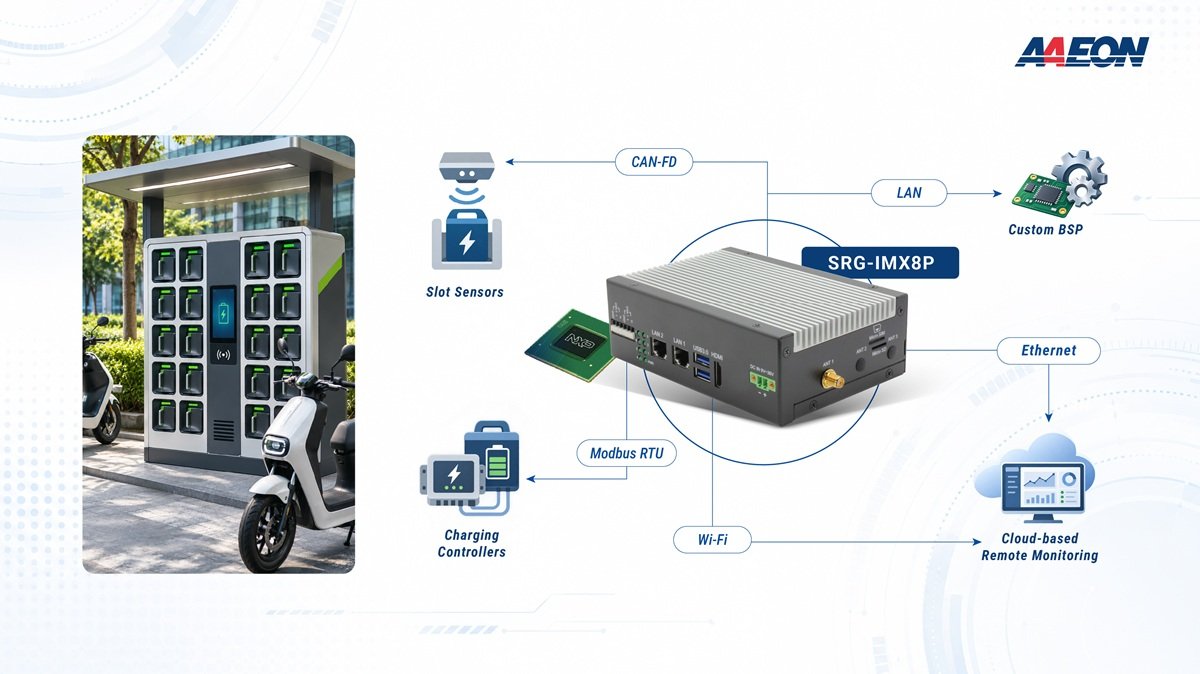
Equipped with two configurable RS-232/422/485 serial interfaces and two CAN-FD channels via dedicated Phoenix connectors, the SRG-IMX8P provided the connectivity to acquire operational data from station equipment. For example, battery voltage, current, temperature, and charging status were communicated from station charging controllers to the gateway over RS-485 using Modbus RTU, while slot sensors provided information on battery slot availability.
The SRG-IMX8P’s NXP i.MX 8M Plus Arm® Cortex®-A53 processor provided the computing platform for the gateway application, consolidating data from station subsystems prior to its transmission to the customer’s cloud platform. As a result, the application software could generate a unified view of battery charging, slot availability, and other operational information for each station.
With two Gigabit Ethernet ports, the system could connect to separate local and upstream networks. Meanwhile, optional Wi-Fi and 4G connectivity, alongside support for MQTT-based communication, meant the SRG-IMX8P could transmit data from across distributed battery-swapping stations to the customer’s cloud platform.
To meet the customer’s software requirements, the software team from AAEON’s RISC Computing Division provided a customized Board Support Package (BSP) for Debian 12 (Bookworm). Key deliverables included a version of the Linux kernel 6.1.36-rt12AA incorporating PREEMPT_RT real-time patches, a U-Boot build configured for the SRG-IMX8P’s 4GB LPDDR4 configuration, and the corresponding Device Tree Source (DTS).
In addition to these components, AAEON provided comprehensive documentation outlining the procedures required to build the kernel from the NXP GitHub repository, as well as guidance on merging U-Boot, the kernel, and the root filesystem (rootfs).
With these custom components and the tools needed to reproduce the build process, the customer could leverage an established, repeatable approach to configuring the SRG-IMX8P’s software, making it easier to maintain a consistent software configuration across new gateways as their network expanded.
With a compact 140.76mm x 98.2mm x 48mm form factor, fanless design, and operating temperature range of -20°C to 70°C, the SRG-IMX8P could handle the environmental challenges that installation in space-constrained station cabinets brought. The system’s broad 9V to 36V power input range meant it could be installed at sites with different power architectures, while its IEC 60068-2-27 and IEC 60068-2-64 tested shock and vibration resistance added another layer of protection when installed in roadside cabinets and other high-traffic locations.
The SRG-IMX8P’s low power consumption was another advantage for a distributed deployment model requiring consistent equipment monitoring workloads. With full-load testing resulting in a power draw of just 9.36W, the device was remarkably power efficient, helping to minimize the gateway's contribution to overall station power consumption.

After establishing proof of concept and extensive compatibility testing of the solution using the SRG-IMX8P, the customer proceeded with deployment to expand its station network. To date, the customer has deployed more than 200 battery-swapping stations across multiple cities, all using the SRG-IMX8P as their embedded gateway. Furthermore, the customer reported that its battery-swapping station network uptime was a resounding 99.6%.
In order to expand their battery-swapping station network, the customer needed access to reliable on-site data from multiple locations to both support day-to-day operations and plan battery and resource allocation as demand changes. Making station-level equipment data accessible from its cloud-based management platform was therefore necessary in order to establish a repeatable architecture for further network expansion.
By acting as the gateway between the two, the SRG-IMX8P provided a way to aggregate and transmit data such as battery charging, slot availability and equipment status from across the station network. Centralized monitoring also helped personnel identify issues remotely, supporting more targeted maintenance responses and helping to reduce station downtime.
Beyond day-to-day monitoring, the data acquired from its network of SRG-IMX8P gateways could be used as input for broader operational planning. When combined with other data sources, this information could help guide battery allocation and demand forecasting across different locations, supporting data-driven decisions as the customer continued expanding into new markets.
Established in 1992, AAEON is one of the leading designers and manufacturers of industrial IoT and AI Edge solutions. With continual innovation as a core value, AAEON provides reliable, high-quality computing platforms including industrial motherboards and systems, rugged tablets, embedded AI Edge systems, uCPE network appliances, and LoRaWAN/WWAN solutions. AAEON also provides industry-leading experience and knowledge to provide OEM/ODM services worldwide. AAEON also works closely with cities and governments to develop and deploy Smart City ecosystems, offering individual platforms and end-to-end solutions. AAEON works closely with premier chip designers to deliver stable, reliable platforms. For an introduction to AAEON’s expansive line of products and services, visit www.aaeon.com.



