- Resources
- Application Stories
- Warehouse Picking Trolley Touchscreen Terminal
Executive Summary
With the growth of e-commerce platforms and delivery speed becoming an increasingly important factor in consumer purchasing decisions, fulfilment centers face the difficult task of scaling their operations to keep up with accelerating demand while maintaining high standards in both efficiency and picking accuracy. For fulfilment centers processing thousands of products each day, a single error can lead to downstream inspection and reconciliation, which according to widely cited industry research can cost hundreds of thousands of dollars annually. As a result, many organizations are looking toward operator-assisted digitalization as a way to keep up with market demand.
One such organization, a quiet giant with a decades-long history in the logistics sector, approached AAEON with the ambition of adding a mounted industrial touchscreen terminal to the next generation of its order picking trolleys. The objective was to provide operatives a portal that could display item locations, confirm completed picks, and verify barcode and weight data from trolley sensors against warehouse management system (WMS) order information.
By doing this at the picking stage of the fulfilment process, the customer hoped the terminal would reduce the number of discrepancies occurring during downstream inspection even when scaling operations.
Key Application Requirements
- A rugged touchscreen HMI to show order details, confirm product picks, and give information on item location mapped to the warehouse for efficient navigation.
- Deliver configurable audio feedback through physical volume buttons for operators to distinguish successful picks from barcode or weight validation failures.
- Interface with trolley-mounted industrial sensors for real-time barcode and weight verification.
- Process multiple data streams to validate products selected against orders received from WMS order logs.
- Maintain wired and wireless connectivity to continuously synchronize with the WMS wherever it was on the warehouse floor.
- Operate reliably on mobile equipment despite vibration, shock, temperature variation, and other environmental stress.
From COM Module to Complete Solution Through Customization
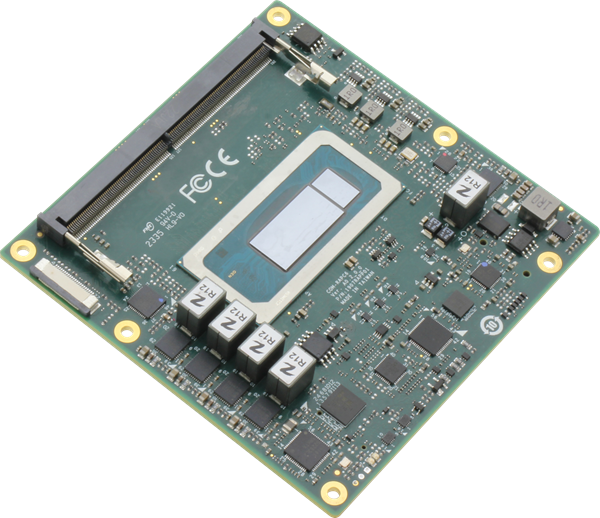
Because of its 13th Generation Intel® Core™ processing foundation, broad interface selection, and robust design, the company selected AAEON’s COM-RAPC6 as the primary controller for the terminal.
Although the module offered an array of features capable of fulfilling the application’s requirements, each interface needed to be routed to the physical connectors for the application. AAEON therefore developed a custom carrier board and project-defined enclosure, effectively turning a COM module into a production-ready embedded platform.
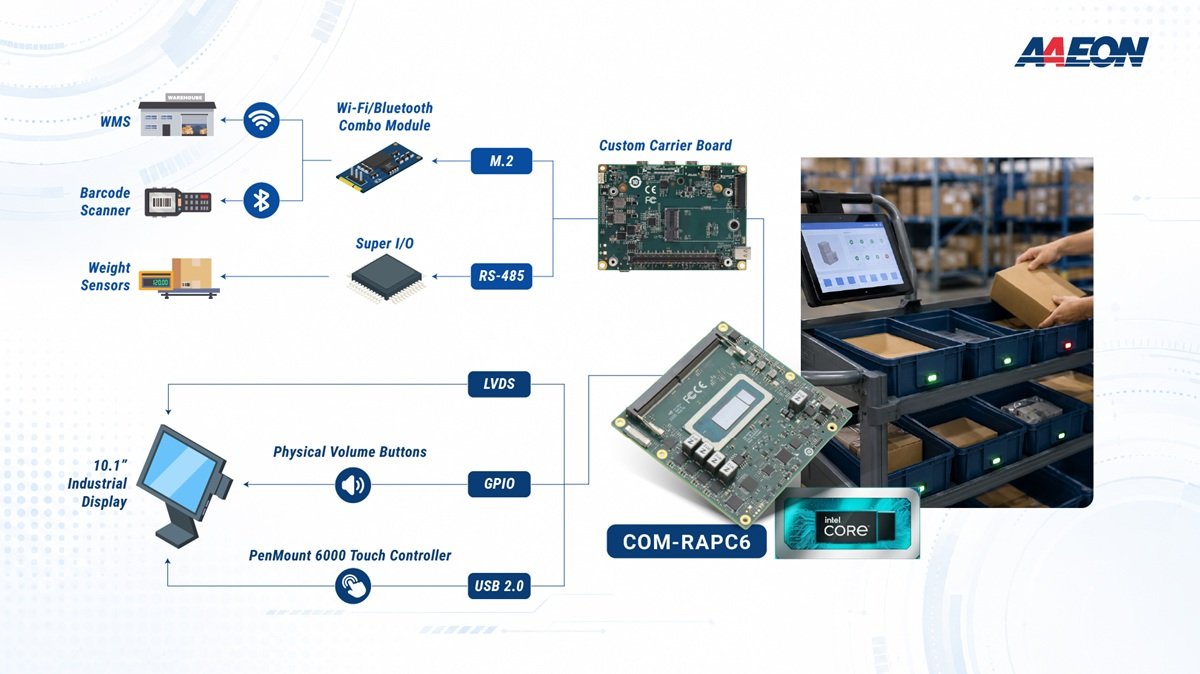
Following a review of the application's functional requirements, the COM-RAPC6 interfaces best suited to each application subsystem were identified and exposed through this custom carrier board.
Super I/O Firmware Customization for Deterministic Communication
The terminal's touchscreen served as the primary interface for fulfilment staff on the ground, but the information it processed came from the trolley's integrated peripherals, such as weight sensors in the trolley’s compartments.
To relay data from the sensors to the module for analysis, the COM-RAPC6's LPC pins were connected to three configurable serial interfaces on the terminal’s carrier board by way of a dedicated Super I/O controller.
Configured to RS-485 mode, these enabled communication with the trolley's integrated weight sensors used to validate each pick. This information was then compared with WMS order details such as expected SKU number and product weight, flagging discrepancies via the terminal's audio function.
However, given the customer required the terminal to run on a Windows 11 operating system, direction switching latency during half-duplex RS-485 communication was a concern. To prevent this, AAEON’s technical team took an agile approach, configuring the carrier board’s Super I/O chip for Hardware Auto-RS-485 Direction Control, rather than relying on the system’s OS to toggle the Request-to-Send (RTS) lines for half-duplex RS-485 communication. With this configuration, the application software could simply write data to the carrier board’s COM port and read responses without having to manage RTS timings or encountering latency when data was received and the reply transmitted.
To ensure this configuration could produce stable, long-distance operation suitable for electrically noisy warehouse environments, AAEON performed successful validation tests on the customized RS-485 interfaces for half-duplex communication at 115,200 bps over cable lengths of up to 1.2 km, far beyond the distances typically required in warehouse environments.
Wireless Connectivity for Barcode Scanner & WMS Sync
For additional picking conformity, a wireless handheld Bluetooth barcode scanner was connected to the terminal. Providing this connection was a Wi-Fi/Bluetooth combo module installed on the carrier board’s M.2 2230 E-Key slot. The choice of a Bluetooth connection was a practical one, as it allowed operators to move freely during the picking process without wires obstructing their mobility.
High-Performance Local Compute
For this application, the customer opted for a non-standard COM-RAPC6 SKU equipped with the Intel® Core™ i5-1335UE Processor and 16GB of DDR5. This was because it offered the substantial computing power of 10 cores and 12 threads with a modest 15W TDP, whereas options with similar performance from the module’s default CPU lineup ranged from 28W to 45W. As such, the Intel® Core™ i5-1335UE Processor provided a middle-ground that meant it could handle multiple concurrent data streams without compromising system responsiveness while maintaining adequate thermal headroom.
For the application’s operating system, a 256GB NVMe SSD was preinstalled in the carrier board’s M.2 2280 M-Key slot, routed through the COM-RAPC6's PCIe Gen 3 interface. This drive also provided local storage for configuration data and transaction logs generated during warehouse operations.
Environmentally Robust Housing
To protect the COM-RAPC6, the custom carrier board, and provide physical ports through which to connect peripheral devices, AAEON installed both the COM-RAPC6 and its carrier board inside a custom-built embedded enclosure. This housing included the LVDS-powered 10.1” touchscreen, speakers, and physical buttons that operators needed.
To protect the hardware from the voltage and temperature variability commonly encountered in warehouse environments, the system was engineered to tolerate power inputs ranging from 9V to 36V, as well as providing power protection. The system also underwent testing to ensure it could withstand high levels of vibration and shock, critical for its proposed deployment role. Finally, to bolster the longevity of its touchscreen, the terminal’s front panel achieved IP54 protection, helping safeguard the operator interface against dust and moisture exposure.
Application Architecture
Business Impact
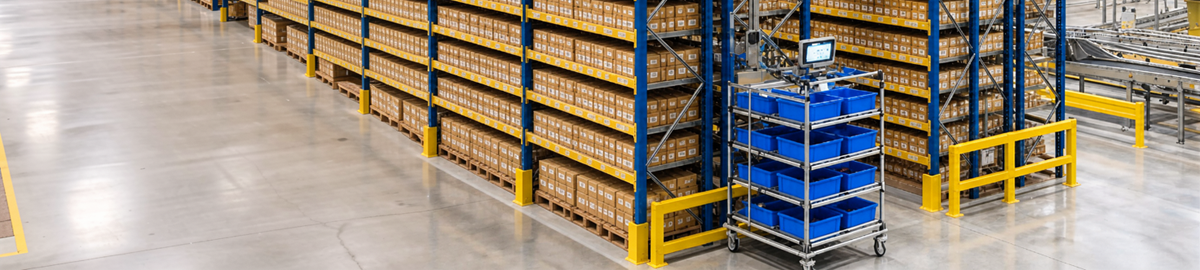
The client was keen to fully roll out the next generation of their warehouse trolley, and AAEON’s detailed approach to solution building strengthened their confidence in pushing the final product to market. Beginning with a test run featuring a small number of units, the client was satisfied with the impact the terminal had, as well as its compatibility with its trolley’s integrated peripherals. By shifting verification from downstream inspection to the point of picking, the solution helped prevent errors before they entered subsequent fulfillment processes. As a result, the green light was given for a fleet of several hundred to be deployed.
The solution provided tangible results, with the client reporting that through the use of weight control data and barcode scanning, their order picking operatives had achieved 100% conformity for picks processed through the trolley system.
The client also reported that AAEON’s customization of the system’s Super I/O firmware was incredibly reliable, successfully processing weight data generated by the trolley’s precision weighing sensors capable of detecting weight variations down to 0.1g for small-item picking workflows.
In addition to this, the terminal’s intuitive touchscreen UI dramatically reduced the time required to train new staff on fulfillment procedures, providing product locations, order details, and trolley container assignments directly at the point of work.